
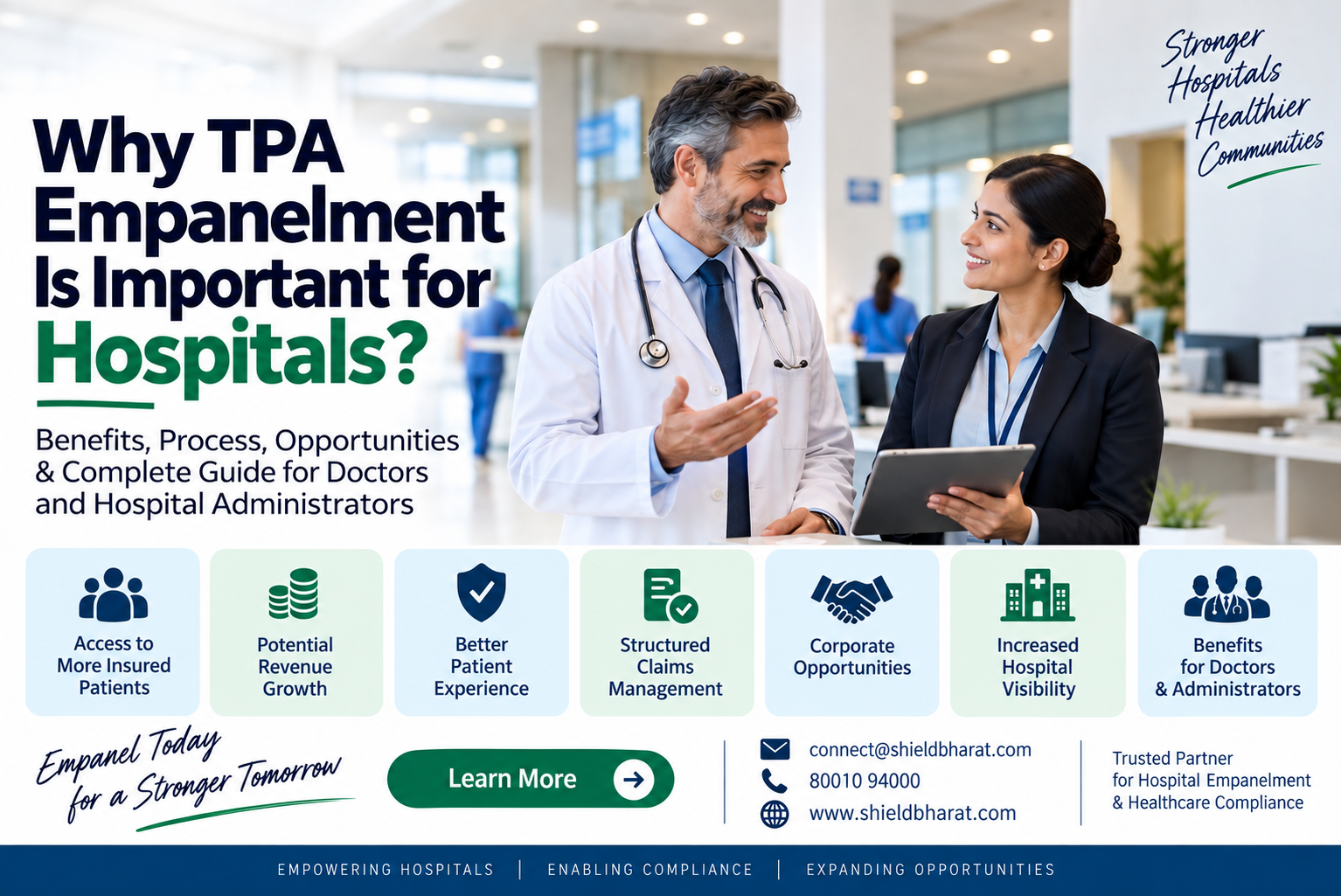
TPA Empanelment for Hospitals | Hospital Insurance Empanelment | Cashless Healthcare Services | Insurance Network Setup
For a modern hospital, providing excellent medical treatment is only one part of building a successful healthcare organization. Patients and their families are increasingly concerned about another important question:
“Can I use my health insurance or cashless facility at this hospital?”
This question has changed the way patients select hospitals.
A hospital may have experienced doctors, advanced medical equipment, qualified nurses, modern infrastructure and excellent patient care. But if the hospital is not connected with relevant insurance companies and Third Party Administrators (TPAs), many insured patients may choose another hospital where cashless treatment is available.
This is where TPA empanelment becomes important.
TPA empanelment can help hospitals become part of an insurer/TPA network, subject to the applicable insurer or TPA requirements and agreement. In network arrangements, eligible insured patients may be able to access cashless treatment according to their policy terms, pre-authorisation requirements, hospital agreement and applicable procedures.
IRDAI-related policy documents describe a network provider as a hospital or healthcare provider enlisted by an insurer or by a TPA and insurer together to provide medical services to insured persons through a cashless facility.
For hospital administrators, therefore, TPA empanelment should not be viewed simply as another administrative formality.
It can become an important part of:
- Patient acquisition
- Hospital visibility
- Insurance patient access
- Cashless treatment availability
- Revenue opportunities
- Hospital credibility
- Corporate healthcare relationships
- Claim coordination
- Patient convenience
- Long-term hospital growth
What Is TPA Empanelment?
TPA stands for Third Party Administrator.
In the health insurance ecosystem, a TPA can perform administrative and claim-related functions between insured persons, hospitals and insurers, depending on the arrangement and applicable regulations.
TPA empanelment generally means the process through which a hospital applies to become part of the network associated with an insurer/TPA and, after evaluation and approval, enters into the applicable agreement or arrangement.
The process may involve evaluation of:
- Hospital registration
- Infrastructure
- Medical facilities
- Doctors and specialists
- Nursing facilities
- Diagnostic facilities
- Operation theatres
- ICU/NICU facilities, where applicable
- Hospital licences
- Quality certifications
- Pricing
- Tariff structure
- Billing procedures
- Medical records
- Claims documentation
- Bank details
- Legal documents
- Compliance documents
- Hospital policies and procedures
The exact requirements can differ between insurers and TPAs.
It is therefore incorrect to assume that submitting one common application automatically gives a hospital access to every insurer or TPA network.
Each organization can have its own requirements, commercial terms, documentation, review process and empanelment criteria.
Why Is TPA Empanelment Important for Hospitals?
The biggest reason is simple:
Patients increasingly expect insurance-supported healthcare options.
Imagine two hospitals located within the same area.
Both have qualified doctors.
Both have good infrastructure.
Both provide similar treatments.
But Hospital A has multiple relevant insurance/TPA network arrangements while Hospital B does not.
An insured patient may naturally investigate whether the required treatment can be taken through a cashless facility at Hospital A.
That does not mean every patient will select the network hospital, and TPA empanelment does not guarantee patient volume.
However, being part of appropriate healthcare networks can remove one important barrier for insured patients.
1. Access to More Insured Patients
One of the most significant potential advantages of TPA empanelment is access to patients who have health insurance coverage.
India has a large and evolving health insurance ecosystem. For many insured families, the availability of a cashless option is an important factor when deciding where to seek treatment.
A network hospital can potentially receive patients referred through:
- Insurance companies
- TPAs
- Corporate HR departments
- Corporate insurance desks
- Insurance agents
- Brokers
- Policyholders
- Online healthcare searches
- Existing patients
- Referral networks
This can expand the hospital's potential patient base.
For a hospital administrator, this is particularly important because hospital occupancy and patient acquisition directly influence operational sustainability.
2. Cashless Treatment Can Improve Patient Convenience
For eligible treatments at network hospitals, cashless arrangements can allow the insurer/TPA to settle eligible hospital expenses directly with the hospital, subject to policy terms, authorisation and other applicable requirements.
IRDAI-hosted policy documents describe cashless facilities at network hospitals and explain that eligible hospital bills can be settled directly by the insurer/TPA subject to the applicable formalities and policy conditions.
This can reduce the immediate financial burden on patients for admissible expenses.
However, hospitals must communicate one important point clearly:
Cashless does not necessarily mean that every expense is automatically covered.
Depending on the policy, treatment and authorisation:
- Deductibles may apply
- Co-payments may apply
- Non-medical expenses may be excluded
- Policy limits may apply
- Room-rent limits may apply
- Package rates may apply
- Certain procedures may require pre-authorisation
- Some expenses may be inadmissible
- Final claim settlement remains subject to policy terms and claim assessment
Therefore, hospital billing and insurance desks must explain the patient's financial responsibility before discharge wherever practicable.
3. Better Patient Experience
Healthcare is not only about treatment.
It is also about the patient journey.
A patient entering a hospital may already be worried about:
- Diagnosis
- Surgery
- Treatment cost
- Hospitalisation
- Family responsibilities
- Recovery
- Financial uncertainty
A properly managed insurance desk can make this journey easier.
A professional TPA/insurance desk can assist with processes such as:
- Insurance identification
- Policy verification
- Cashless request
- Pre-authorisation coordination
- Document submission
- Query handling
- Discharge approval coordination
- Final bill submission
- Claim documentation
- Follow-up with the relevant party
The exact process varies by insurer/TPA.
But the objective remains the same:
Reduce unnecessary administrative friction for the patient.
4. Increased Hospital Visibility
Empanelment can also contribute to hospital visibility.
When a hospital becomes part of relevant insurance networks, its details may be available through network hospital directories, insurer/TPA channels or other healthcare information systems, depending on the arrangement.
This creates another route through which insured patients may discover the hospital.
For example, a patient may search for:
“Cashless hospital near me”
or
“Network hospital for my insurance”
or
“Health insurance hospital in Delhi NCR”
If your hospital is appropriately included in the relevant network and information is accurately maintained, it can improve the chance of being considered by that patient.
This is one reason hospital administrators should think about empanelment together with:
- Local SEO
- Google Business Profile
- Hospital website
- Doctor profiles
- Healthcare directories
- Location pages
- Patient education content
- Social media
- Insurance network visibility
TPA empanelment and digital marketing are different activities, but together they can support patient discovery.
5. Potential Revenue Growth
Let's be precise.
TPA empanelment itself does not guarantee revenue growth.
That would be an irresponsible claim.
Revenue depends on many factors, including:
- Hospital location
- Specialties
- Doctor availability
- Pricing
- Reputation
- Patient demand
- Insurance coverage
- Network agreements
- Package rates
- Claim approvals
- Bed capacity
- Clinical outcomes
- Patient experience
- Competition
However, empanelment can create an additional channel for insured patient acquisition.
If a hospital receives more eligible insured patients and maintains effective claim and billing processes, this can contribute to revenue opportunities.
For growing hospitals, this can be strategically significant.
6. Helps Hospitals Compete in the Local Healthcare Market
Healthcare competition has become more sophisticated.
Patients compare hospitals based on:
- Doctors
- Specialties
- Location
- Reviews
- Infrastructure
- Emergency services
- Treatment availability
- Pricing
- Insurance coverage
- Cashless availability
Therefore, hospital administrators need to understand that clinical excellence alone may not be sufficient from a business perspective.
A hospital should also make it easy for patients to understand:
Where can I get treatment?
Which doctors are available?
Which specialties are available?
Can my insurance be used?
What documents do I need?
How does cashless treatment work?
A strong insurance/TPA desk can become an important component of the hospital's patient-service infrastructure.
7. Corporate Patient Opportunities
TPA and insurance networks can also support hospitals that want to develop relationships with corporate healthcare ecosystems.
Companies often provide health insurance benefits to employees and their families.
Employees may therefore search for hospitals where their policy can be used.
Hospitals with relevant network relationships may become more accessible to such patients.
This can create opportunities for hospitals to develop additional relationships involving:
- Corporate health programs
- Employee health check-ups
- Corporate medical camps
- Preventive healthcare
- Occupational health services
- Annual health packages
- Diagnostic services
- Specialist consultations
The hospital administrator should therefore consider TPA empanelment as part of a broader institutional business-development strategy.
8. Supports Structured Claims Management
Insurance claims require documentation.
A hospital must maintain appropriate records and submit required documents according to the relevant process.
These may include:
- Patient registration documents
- Insurance card
- ID proof
- Admission records
- Doctor notes
- Investigation reports
- Treatment records
- Consent forms
- Operation notes
- Discharge summary
- Bills
- Prescriptions
- Diagnostic reports
- Pharmacy records
- Other documents required by the insurer/TPA
A structured TPA desk can help coordinate these documents.
This can reduce avoidable delays caused by incomplete documentation.
However, documentation should never be created merely to satisfy a claim. It must accurately reflect the patient's actual clinical treatment and records.
9. Improves Internal Hospital Processes
TPA empanelment can force hospitals to improve their internal processes.
This can be a positive operational effect.
Hospitals may need stronger systems for:
- Admission
- Insurance verification
- Pre-authorisation
- Medical documentation
- Billing
- Package management
- Discharge
- Claims submission
- Query management
- Outstanding tracking
- Payment reconciliation
As a result, the hospital can build a more structured revenue-cycle workflow.
10. Helps Build Patient Trust
Patients are more comfortable when the hospital has a clearly defined insurance process.
Instead of telling the patient:
“You will have to find out from your insurance company.”
the hospital can have an insurance desk that guides the patient through the appropriate process.
This can improve communication.
But again, transparency is critical.
Hospital staff should never promise:
“Your entire treatment will be covered.”
A more responsible statement is:
“Cashless treatment is subject to your policy coverage, insurer/TPA authorisation and applicable terms and conditions.”
This distinction protects both the patient and the hospital.
Benefits of TPA Empanelment for Doctors
Doctors sometimes see TPA empanelment as an administrative issue handled by hospital management.
That is only partly true.
Insurance processes can affect the patient's treatment journey and therefore indirectly affect the doctor-patient experience.
Doctors can benefit through:
Better Patient Access
Patients with insurance may be more willing to seek treatment at hospitals where their insurance can be used.
Greater Hospital Reach
A hospital connected with relevant networks may attract patients beyond its existing referral base.
More Structured Documentation
Insurance processes encourage proper clinical documentation.
Improved Institutional Reputation
Hospitals that provide organized insurance support can create a more professional patient experience.
Reduced Financial Anxiety for Patients
When eligible cashless treatment is available, patients may face less immediate financial pressure for covered expenses.
Benefits for Hospital Administrators
For hospital administrators, the benefits are broader.
TPA empanelment can support:
- Patient acquisition
- Insurance revenue channels
- Corporate patient access
- Hospital network development
- Patient convenience
- Cashless service availability
- Structured billing
- Claims management
- Documentation discipline
- Revenue-cycle management
- Hospital credibility
- Market expansion
The administrator should monitor these processes using measurable KPIs.
For example:
Insurance Department KPIs
- Number of cashless requests
- Number of approvals
- Approval turnaround time
- Number of queries
- Query resolution time
- Claim submission time
- Outstanding claim amount
- Average receivable period
- Rejection rate
- Deduction amount
- Discharge approval time
- Insurer/TPA-wise performance
This converts TPA management from a passive administrative function into a measurable operational function.
What Happens If a Hospital Is Not Empanelled?
Being non-empanelled does not mean that patients cannot necessarily receive treatment.
Depending on the policy, reimbursement may still be possible through the applicable process.
Some insurance policy documents distinguish between network and non-network hospitals and provide reimbursement processes for non-network treatment.
However, patients may face a different payment process.
For example, they may need to:
- Pay the hospital initially.
- Collect the required documents.
- Submit the claim.
- Wait for reimbursement.
- Receive reimbursement according to policy terms and claim assessment.
That can be financially difficult for some families.
This is one reason patients may prefer hospitals where their policy's eligible cashless facility is available.
TPA Empanelment Is Not the Same as Insurance Company Empanelment
This distinction is important.
A hospital may work with:
- Insurance companies
- TPAs
- Government healthcare schemes
- Corporate health programs
- Public-sector insurance networks
- Private healthcare networks
The exact relationship depends on the arrangement.
A TPA may administer claims or provide related services on behalf of insurers, but the TPA does not simply replace the insurer.
Hospital administrators should understand:
Who is the insurer?
Who is the TPA?
What is the agreement?
What are the package rates?
What is the authorisation procedure?
What documents are required?
Who makes the final claim decision?
This prevents operational confusion.
Common Documents Required for Hospital Empanelment
Requirements differ between organizations, but hospitals may commonly be asked for documents such as:
Hospital Legal Documents
- Hospital registration certificate
- PAN
- GST certificate, where applicable
- Registration/incorporation documents
- Ownership documents
- Address proof
Clinical Documents
- Doctors' registration details
- Qualification certificates
- Nursing registration details
- Specialist details
- Staff information
Infrastructure Documents
- Bed capacity
- ICU details
- OT details
- Diagnostic facilities
- Pharmacy information
- Emergency facilities
- Ambulance information
Financial Documents
- Bank details
- Cancelled cheque
- Tariff list
- Package rates
- Financial information as requested
Quality & Compliance
Depending on the hospital and network:
- NABH-related documentation
- NABL-related documentation for laboratories
- Fire safety documentation
- Biomedical waste compliance
- Pollution control documentation
- Pharmacy licence
- Blood bank licence, where applicable
- Other statutory approvals
The exact list must be confirmed with the relevant insurer/TPA.
How Does the TPA Empanelment Process Work?
While every organization may follow its own process, a typical hospital empanelment workflow can look like this:
Step 1: Hospital Assessment
First, determine:
- Hospital specialty
- Location
- Number of beds
- Clinical departments
- Facilities
- Target patient segment
- Existing insurance relationships
- Required networks
Step 2: Documentation
Prepare the required documentation.
Incomplete documentation can delay the process.
Step 3: Application
Submit the empanelment application to the relevant insurer/TPA/network.
Step 4: Verification
The organization may verify hospital details and infrastructure.
Step 5: Hospital Visit / Inspection
Depending on requirements, a physical or virtual assessment may take place.
Step 6: Commercial Discussion
Tariffs, packages and other commercial terms may be discussed.
Step 7: Agreement
If approved, the relevant agreement or network arrangement is completed.
Step 8: Network Activation
After the applicable onboarding process, the hospital may be activated in the network.
Step 9: Operational Setup
The hospital should establish:
- Insurance desk
- Contact persons
- Pre-authorisation process
- Documentation workflow
- Billing workflow
- Claim submission process
- Query management
Step 10: Continuous Management
Empanelment should not end after approval.
The hospital should continuously monitor:
- Authorisations
- Claims
- Queries
- Deductions
- Payments
- Renewals
- Tariff changes
- Network updates
- Documentation
- Service-level performance
Why Hospitals Should Not Treat Empanelment as a One-Time Activity
This is one of the biggest mistakes hospital administrators make.
Getting empanelled is only the beginning.
The real challenge is managing the relationship.
Consider this:
A hospital gets empanelled.
Patients start arriving.
But the hospital has:
- Slow pre-authorisation
- Poor documentation
- Incorrect bills
- Missing reports
- Delayed claim submission
- Untrained staff
- Unclear package rates
- Poor follow-up
- No outstanding tracking
The result?
The hospital may technically be empanelled but operationally underperforming.
Therefore:
Empanelment + Process + Documentation + Follow-up = Effective Insurance Operations
TPA Empanelment and NABH/NABL: Are They the Same?
No.
These are different concepts.
NABH relates to accreditation and quality standards for healthcare organizations.
NABL relates to accreditation of laboratories and certain conformity assessment activities.
TPA empanelment relates to network/insurance arrangements and associated processes.
A hospital may pursue multiple certifications, registrations and empanelments depending on its strategy and requirements.
Quality accreditation can strengthen a hospital's institutional profile, but it should not be represented as an automatic guarantee of TPA empanelment.
How TPA Empanelment Can Support Hospital Marketing
Hospital marketing should not be based only on:
“Best Hospital”
or
“Top Hospital”
Patients need useful information.
A hospital website should clearly communicate:
- Departments
- Doctors
- Treatments
- Emergency services
- Insurance information
- TPA/network information
- Cashless process
- Appointment booking
- Contact details
- Location
- FAQs
- Patient guides
For SEO, hospitals can create useful pages such as:
Cashless Hospital in [City]
TPA Network Hospital in [City]
Health Insurance Hospital in [Location]
Cashless Hospital for [Insurance/TPA], where accurate and officially applicable
Insurance Desk at [Hospital Name]
However, hospitals should only publish network affiliations that are currently valid and should regularly update them.
Why Hospitals Need Professional Help With TPA Empanelment
The process can become complicated when a hospital wants to approach multiple networks.
Hospital management teams already have to handle:
- Doctors
- Patients
- Nurses
- Billing
- Pharmacy
- Operations
- Compliance
- HR
- Procurement
- Quality
- Finance
Adding insurance empanelment without specialized knowledge can create additional workload.
Professional support can help hospitals with:
- Documentation preparation
- Application coordination
- Empanelment strategy
- TPA/insurance coordination
- Follow-up
- Hospital profile preparation
- Tariff documentation
- Compliance checklist
- Query response coordination
- Empanelment status tracking
This does not mean an external consultant can guarantee approval.
Approval remains dependent on the relevant insurer/TPA/network's requirements, evaluation and commercial decision.
Why Shield Bharat Consulting Can Help
Shield Bharat Consulting focuses on helping hospitals navigate healthcare empanelment, compliance and insurance-related processes.
The organization works around services such as:
- Hospital Empanelment
- TPA Empanelment
- GIC Empanelment
- GIPSA Empanelment
- Insurance Empanelment
- ECHS-related empanelment support
- PMJAY / Ayushman Bharat support
- NABH support
- Pre-NABH support
- NABL guidance
- Healthcare compliance
- Insurance network setup
- ROHINI registration-related support
- DGHS-related processes
- ESIC-related processes
For hospitals considering insurance network expansion, the first step should be an assessment of the hospital's existing documentation, infrastructure, specialties, location, pricing and target networks.
Connect With Shield Bharat Consulting
Email: connect@shieldbharat.com
Mobile: 80010 94000
Website: www.shieldbharat.com
Visit Shield Bharat Consulting to learn more about hospital empanelment and healthcare consulting services.
What Should a Hospital Prepare Before Applying?
Before starting the empanelment process, hospital management should prepare a structured file containing:
Hospital Profile
- Hospital name
- Address
- Contact details
- Ownership details
- Years of operation
- Number of beds
- Specialties
Medical Team
- Doctors
- Consultants
- Specialists
- Nursing team
- Technicians
Infrastructure
- ICU
- OT
- Emergency
- Pharmacy
- Diagnostics
- Radiology
- Laboratory
- Ambulance
- Other facilities
Compliance
- Registrations
- Licences
- Fire safety
- Biomedical waste
- Pollution-related documents
- Clinical registrations
- Applicable certifications
Financial Information
- Bank details
- Tariff
- Package rates
- Billing details
Insurance Operations
- Insurance desk
- Existing TPAs
- Existing insurers
- Claim coordinator
- Contact person
- Billing team
The more organized the documentation, the easier it becomes to manage multiple applications.
10 Mistakes Hospitals Should Avoid
1. Applying Without Checking Eligibility
Do not apply blindly.
First understand the network's requirements.
2. Incomplete Documentation
Missing documents create unnecessary delays.
3. Incorrect Hospital Information
Hospital name, address, bed count, doctor details and licences should be accurate.
4. Unrealistic Revenue Expectations
Empanelment is not a guarantee of patient volume.
5. Poor Billing
Incorrect billing creates avoidable queries and disputes.
6. Weak Medical Documentation
Clinical records must accurately reflect actual treatment.
7. No Dedicated Insurance Desk
Without trained personnel, cashless operations can become chaotic.
8. Ignoring Outstanding Claims
Approved claims still need proper tracking until payment reconciliation.
9. Not Monitoring Network Status
Hospital management should verify whether network relationships remain active and whether tariffs or procedures have changed.
10. Making False Marketing Claims
Never advertise a hospital as cashless for a particular insurer/TPA unless the relationship is valid and current.
Frequently Asked Questions About TPA Empanelment
Is TPA empanelment mandatory for a hospital?
No universal statement can be made that every hospital must obtain TPA empanelment. It depends on the hospital's business model, patient segment, insurance relationships and applicable requirements.
However, for hospitals targeting insured patients and cashless network business, relevant empanelment can be strategically important.
Does TPA empanelment guarantee cashless treatment?
No.
Cashless treatment is generally subject to the patient's policy, network status, pre-authorisation, treatment eligibility, documentation and applicable terms.
Network status alone does not mean every claim or every expense will be approved.
Does TPA empanelment guarantee more patients?
No.
It creates a potential channel for insured patients but does not guarantee patient volume.
Hospital location, reputation, doctors, specialty, pricing, service quality and market demand continue to matter.
Can a small hospital apply for TPA empanelment?
Potentially, yes, depending on the relevant network's eligibility criteria.
The hospital should assess its facilities, documentation, specialties, infrastructure and commercial suitability before applying.
Is NABH required for TPA empanelment?
Not necessarily in every case.
Requirements differ among networks and healthcare programs.
The hospital should verify the specific requirements applicable to the intended empanelment.
Can a hospital be empanelled with multiple TPAs?
A hospital may have relationships with multiple insurers/TPAs/networks, subject to their respective eligibility criteria and agreements.
The hospital must manage each relationship separately.
How long does TPA empanelment take?
There is no single universal timeline.
The duration can depend on:
- Documentation
- Hospital verification
- Inspection
- Commercial negotiations
- Agreement
- Internal approval
- Network onboarding
Hospitals should avoid anyone promising a guaranteed approval timeline without knowing the specific organization and process.
The Strategic Importance of TPA Empanelment
For hospital owners and administrators, the bigger picture is important.
Healthcare is moving toward a more connected ecosystem.
Patients want:
Quality treatment + Convenience + Financial accessibility + Transparency
Insurance networks can become part of that ecosystem.
A hospital that combines:
Strong clinical services
Qualified doctors
Good patient experience
Professional insurance desk
Relevant TPA/insurance relationships
Efficient claims management
Digital visibility
is better positioned to serve insured patients efficiently.
Again, this does not guarantee business success.
But it can remove an important barrier between the patient and the hospital.
TPA Empanelment Checklist for Hospital Administrators
Before beginning, ask these questions:
Hospital
☐ Is the hospital legally registered?
☐ Are all required licences available?
☐ Is the hospital profile updated?
☐ Are bed details accurate?
Doctors
☐ Are doctor qualifications documented?
☐ Are registration details available?
☐ Are specialist details updated?
Infrastructure
☐ Is the infrastructure clearly documented?
☐ Are ICU/OT/emergency details available?
☐ Are diagnostic facilities documented?
Compliance
☐ Fire safety documentation available?
☐ Biomedical waste documentation available?
☐ Other applicable statutory documents available?
Finance
☐ Bank details ready?
☐ Tariff list ready?
☐ Package rates ready?
Insurance
☐ Insurance coordinator appointed?
☐ Billing team trained?
☐ Pre-authorisation process defined?
☐ Claim documentation process defined?
☐ Outstanding claim tracking available?
If the answer to several of these questions is “No”, the hospital should organize its internal documentation before aggressively pursuing multiple empanelments.
Final Thoughts: TPA Empanelment Is a Hospital Business Strategy, Not Just Paperwork
The healthcare industry is becoming increasingly patient-centric and insurance-driven.
For doctors, hospital owners and administrators, the question should not simply be:
“How do we get empanelled?”
The better question is:
“How do we build an efficient insurance and cashless healthcare system that benefits our patients while maintaining sustainable hospital operations?”
That requires more than an application.
It requires:
- Correct documentation
- Appropriate network selection
- Professional coordination
- Transparent billing
- Strong medical records
- Trained insurance staff
- Efficient pre-authorisation
- Timely claim submission
- Outstanding tracking
- Patient communication
- Continuous compliance
TPA empanelment can help a hospital become accessible to a wider pool of insured patients, improve convenience for eligible cashless cases, and develop relationships within the insurance healthcare ecosystem.
But the hospital must manage the entire process professionally.
Empanelment gets you into the network.
Operational excellence determines what happens after that.
Need Help With Hospital TPA Empanelment?
If you are a:
Doctor | Hospital Owner | Hospital Administrator | Medical Director | Hospital Manager | Billing Head | Insurance Desk Manager
and you are planning to expand your hospital's insurance and healthcare network relationships, professional guidance can help you understand the process, documentation and applicable requirements.
Talk to Shield Bharat Consulting
Hospital Empanelment | TPA Empanelment | GIPSA Empanelment | GIC Empanelment | PMJAY | NABH Support | NABL Guidance | Insurance Network Setup
Email: connect@shieldbharat.com
Mobile: 80010 94000
Website: www.shieldbharat.com
Explore Hospital Empanelment Services:
https://shieldbharat.com
Disclaimer: TPA/insurer empanelment, cashless treatment, claim approval and payment are subject to the requirements, agreements, policy terms, authorisation procedures and decisions of the relevant insurer/TPA/network and applicable laws/regulations. Empanelment or consultancy support does not guarantee approval, patient volume, claim settlement or revenue.