
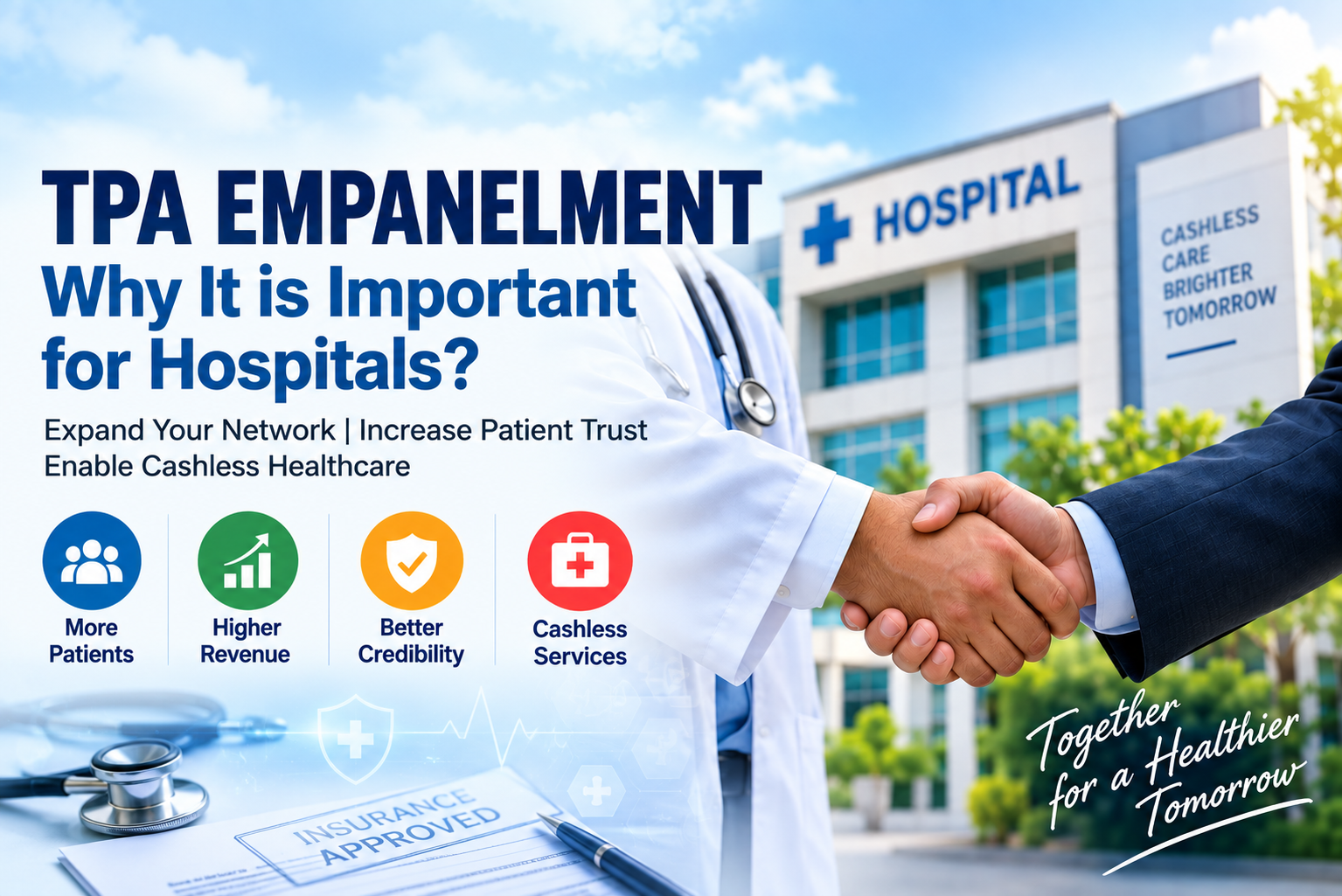
TPA empanelment has become an important
operational and commercial consideration for hospitals that want to serve
insured patients. A hospital may have capable doctors, modern equipment and
strong clinical outcomes, but those strengths do not automatically place the
facility inside an insurance network. Empanelment creates the administrative
and contractual connection through which eligible insured patients can access
network-based services, subject to the patient's policy, authorization
requirements, hospital terms and the insurer or TPA's procedures. TPA
empanelment has become an important operational and commercial consideration
for healthcare facilitys that want to serve insured patients. A healthcare
facility may have capable doctors, modern equipment and strong clinical
outcomes, but those strengths do not automatically place the facility inside an
insurance network. Empanelment creates the administrative and contractual
connection through which eligible insured patients can access network-based services,
subject to the patient's policy, authorization requirements, healthcare
facility terms and the insurer or TPA's procedures.
In practice, the right approach is to
document the process, assign ownership and review the requirements before
submission. The hospital should maintain a master compliance folder, a current
tariff sheet and a panel-wise checklist so that changes can be handled without
rebuilding the entire file.
What TPA empanelment means
A Third Party Administrator, commonly
called a TPA, can perform health insurance-related administrative functions on
behalf of insurers. For a hospital, empanelment generally means that the
facility has been assessed and accepted into a provider network under
applicable terms. The exact arrangement differs between insurers and TPAs. Some
insurers manage provider networks directly, while others use TPAs for network
and claims administration. A Third Party Administrator, commonly called a TPA,
can perform health insurance-related administrative functions on behalf of
insurers. For a healthcare facility, empanelment generally means that the
facility has been assessed and accepted into a provider network under
applicable terms. The exact arrangement differs between insurers and TPAs. Some
insurers manage provider networks directly, while others use TPAs for network
and claims administration.
In practice, the right approach is to
document the process, assign ownership and review the requirements before
submission. The hospital should maintain a master compliance folder, a current
tariff sheet and a panel-wise checklist so that changes can be handled without
rebuilding the entire file.
Why cashless access matters
For eligible policyholders, network access
can make planned or emergency hospitalization administratively easier because
the hospital and insurer/TPA coordinate authorization and claim documentation.
Cashless treatment is not an unconditional promise that every bill will be
paid. Coverage, policy terms, exclusions, authorization, package rules, medical
necessity and documentation all remain relevant. Hospitals therefore need a
process that is clinically sound and administratively disciplined. For eligible
policyholders, network access can make planned or emergency healthcare
facilityization administratively easier because the healthcare facility and
insurer/TPA coordinate authorization and claim documentation. Cashless
treatment is not an unconditional promise that every bill will be paid.
Coverage, policy terms, exclusions, authorization, package rules, medical
necessity and documentation all remain relevant. Healthcare providers therefore
need a process that is clinically sound and administratively disciplined.
In practice, the right approach is to
document the process, assign ownership and review the requirements before
submission. The hospital should maintain a master compliance folder, a current
tariff sheet and a panel-wise checklist so that changes can be handled without
rebuilding the entire file.
Patient acquisition and market visibility
Insurance network participation can make a
hospital visible to people who actively search for network facilities. This is
particularly relevant in urban markets, corporate health programs and areas
where insured patients compare hospitals based on cashless availability.
Empanelment should not be treated as a guaranteed patient-volume formula.
Network demand, local competition, specialty mix, insurer relationships and
patient experience all influence actual admissions. Insurance network
participation can make a healthcare facility visible to people who actively
search for network facilities. This is particularly relevant in urban markets,
corporate health programs and areas where insured patients compare healthcare
facilitys based on cashless availability. Empanelment should not be treated as
a guaranteed patient-volume formula. Network demand, local competition,
specialty mix, insurer relationships and patient experience all influence
actual admissions.
In practice, the right approach is to
document the process, assign ownership and review the requirements before
submission. The hospital should maintain a master compliance folder, a current
tariff sheet and a panel-wise checklist so that changes can be handled without
rebuilding the entire file.
Corporate and institutional relationships
Hospitals that participate in insurer and
TPA networks may become relevant to corporate employees and other insured
groups whose policies use network providers. This can broaden the hospital's
addressable market. The hospital should still examine the financial and
operational terms of each network rather than pursuing every panel without
analysis. Healthcare providers that participate in insurer and TPA networks may
become relevant to corporate employees and other insured groups whose policies
use network providers. This can broaden the healthcare facility's addressable
market. The healthcare facility should still examine the financial and
operational terms of each network rather than pursuing every panel without
analysis.
In practice, the right approach is to
document the process, assign ownership and review the requirements before
submission. The hospital should maintain a master compliance folder, a current
tariff sheet and a panel-wise checklist so that changes can be handled without
rebuilding the entire file.
Financial and operational discipline
Empanelment can increase insured-case
volume, but it also increases the importance of accurate billing,
authorization, medical documentation and claims follow-up. Hospitals that
accept network cases without understanding package inclusions, tariff limits
and documentation rules can experience deductions, delays or disputes. The
commercial question is therefore not simply whether a panel brings patients; it
is whether the hospital can serve those patients efficiently under sustainable
terms. Empanelment can increase insured-case volume, but it also increases the
importance of accurate billing, authorization, medical documentation and claims
follow-up. Healthcare providers that accept network cases without understanding
package inclusions, tariff limits and documentation rules can experience
deductions, delays or disputes. The commercial question is therefore not simply
whether a panel brings patients; it is whether the healthcare facility can
serve those patients efficiently under sustainable terms.
In practice, the right approach is to
document the process, assign ownership and review the requirements before
submission. The hospital should maintain a master compliance folder, a current
tariff sheet and a panel-wise checklist so that changes can be handled without
rebuilding the entire file.
Common preparation areas
Hospitals should prepare registrations and
licenses, hospital profile, bed and specialty information, doctor details, bank
information, tariff schedules, accreditation documents where applicable,
statutory compliance records and facility photographs. Exact requirements vary.
A practical pre-application audit should identify missing, expired or
inconsistent documents before submission. Healthcare providers should prepare
registrations and licenses, healthcare facility profile, bed and specialty
information, doctor details, bank information, tariff schedules, accreditation
documents where applicable, statutory compliance records and facility
photographs. Exact requirements vary. A practical pre-application audit should
identify missing, expired or inconsistent documents before submission.
In practice, the right approach is to
document the process, assign ownership and review the requirements before
submission. The hospital should maintain a master compliance folder, a current
tariff sheet and a panel-wise checklist so that changes can be handled without
rebuilding the entire file.
ROHINI and compliance readiness
ROHINI registration is commonly relevant to
hospital-network processes in India, and Shield Bharat's current service
information describes ROHINI support as part of its empanelment journey.
Hospitals should verify the current requirements applicable to their intended
network rather than assuming that one checklist applies everywhere. ROHINI
registration is commonly relevant to healthcare facility-network processes in
India, and Shield Bharat's current service information describes ROHINI support
as part of its empanelment journey. Healthcare providers should verify the
current requirements applicable to their intended network rather than assuming
that one checklist applies everywhere.
In practice, the right approach is to
document the process, assign ownership and review the requirements before
submission. The hospital should maintain a master compliance folder, a current
tariff sheet and a panel-wise checklist so that changes can be handled without
rebuilding the entire file.
Inspection readiness
Where an inspection or verification is
required, the hospital should be prepared to demonstrate that its submitted
information matches the actual facility. Bed capacity, departments, equipment,
emergency services, operating theatres, ICU capability, signage, staffing
records and statutory documents may all become relevant depending on the
reviewing organization. The objective is consistency: what the hospital claims
on paper should be demonstrable on site. Where an inspection or verification is
required, the healthcare facility should be prepared to demonstrate that its
submitted information matches the actual facility. Bed capacity, departments,
equipment, emergency services, operating theatres, ICU capability, signage,
staffing records and statutory documents may all become relevant depending on
the reviewing organization. The objective is consistency: what the healthcare
facility claims on paper should be demonstrable on site.
In practice, the right approach is to
document the process, assign ownership and review the requirements before
submission. The hospital should maintain a master compliance folder, a current
tariff sheet and a panel-wise checklist so that changes can be handled without
rebuilding the entire file.
Tariff and package analysis
Tariff negotiation deserves serious
attention. A hospital should understand room categories, professional fees,
procedures, diagnostics, implants where relevant, consumables, package
inclusions and exclusions before accepting network terms. Management should
calculate internal costs and compare them with proposed reimbursement terms. A
panel that increases admissions but creates persistent negative contribution is
not automatically commercially healthy. Tariff negotiation deserves serious
attention. A healthcare facility should understand room categories,
professional fees, procedures, diagnostics, implants where relevant,
consumables, package inclusions and exclusions before accepting network terms.
Management should calculate internal costs and compare them with proposed
reimbursement terms. A panel that increases admissions but creates persistent
negative contribution is not automatically commercially healthy.
In practice, the right approach is to
document the process, assign ownership and review the requirements before
submission. The hospital should maintain a master compliance folder, a current
tariff sheet and a panel-wise checklist so that changes can be handled without
rebuilding the entire file.
Billing and pre-authorization
Once empanelled, the hospital's front
office, insurance desk, clinical team and billing team must work as one
process. Planned admissions often require pre-authorization. Emergency cases
can have different notification procedures. Staff should know which portal,
form, contact point and timeline applies to each network. The exact process is
defined by the relevant insurer/TPA and policy. Once empanelled, the healthcare
facility's front office, insurance desk, clinical team and billing team must
work as one process. Planned admissions often require pre-authorization.
Emergency cases can have different notification procedures. Staff should know
which portal, form, contact point and timeline applies to each network. The
exact process is defined by the relevant insurer/TPA and policy.
In practice, the right approach is to
document the process, assign ownership and review the requirements before
submission. The hospital should maintain a master compliance folder, a current
tariff sheet and a panel-wise checklist so that changes can be handled without
rebuilding the entire file.
Claims documentation
Claim quality begins before discharge.
Diagnosis, treatment notes, investigation reports, authorization records,
discharge summary, bills, prescriptions and other required documents should be
complete and internally consistent. Missing information can lead to queries,
deductions or delays. A dedicated insurance desk can reduce avoidable errors.
Claim quality begins before discharge. Diagnosis, treatment notes,
investigation reports, authorization records, discharge summary, bills,
prescriptions and other required documents should be complete and internally
consistent. Missing information can lead to queries, deductions or delays. A
dedicated insurance desk can reduce avoidable errors.
In practice, the right approach is to
document the process, assign ownership and review the requirements before
submission. The hospital should maintain a master compliance folder, a current
tariff sheet and a panel-wise checklist so that changes can be handled without
rebuilding the entire file.
Patient communication
Hospitals should explain cashless processes
clearly. Patients should know that authorization and final claim settlement
depend on policy coverage and applicable terms. Transparent communication
reduces misunderstandings and prevents the hospital from making promises it
cannot control. Healthcare providers should explain cashless processes clearly.
Patients should know that authorization and final claim settlement depend on
policy coverage and applicable terms. Transparent communication reduces
misunderstandings and prevents the healthcare facility from making promises it
cannot control.
In practice, the right approach is to
document the process, assign ownership and review the requirements before
submission. The hospital should maintain a master compliance folder, a current
tariff sheet and a panel-wise checklist so that changes can be handled without
rebuilding the entire file.
Monitoring network performance
After empanelment, management should track
admissions, average bill value, authorization turnaround, claim submission
time, deductions, outstanding receivables, query rates and patient complaints.
Reviewing these metrics helps identify which panels are operationally efficient
and where process improvements are needed. After empanelment, management should
track admissions, average bill value, authorization turnaround, claim
submission time, deductions, outstanding receivables, query rates and patient
complaints. Reviewing these metrics helps identify which panels are
operationally efficient and where process improvements are needed.
In practice, the right approach is to
document the process, assign ownership and review the requirements before
submission. The hospital should maintain a master compliance folder, a current
tariff sheet and a panel-wise checklist so that changes can be handled without
rebuilding the entire file.
Why professional support can help
Empanelment involves documentation,
compliance, application tracking and communication with multiple organizations.
A consultant can help organize these tasks, identify gaps and maintain
follow-up. However, hospitals should still retain control over clinical
decisions, contractual approvals, financial acceptance and compliance. No
consultant can legitimately guarantee approval because network decisions depend
on the relevant insurer, TPA or scheme. Empanelment involves documentation,
compliance, application tracking and communication with multiple organizations.
A consultant can help organize these tasks, identify gaps and maintain
follow-up. However, healthcare facilitys should still retain control over
clinical decisions, contractual approvals, financial acceptance and compliance.
No consultant can legitimately guarantee approval because network decisions
depend on the relevant insurer, TPA or scheme.
In practice, the right approach is to
document the process, assign ownership and review the requirements before
submission. The hospital should maintain a master compliance folder, a current
tariff sheet and a panel-wise checklist so that changes can be handled without
rebuilding the entire file.
Conclusion
TPA empanelment can be an important
component of a hospital's insurance-network strategy. It can support cashless
access for eligible patients, broaden market visibility and create
opportunities to serve insured and institutional populations. The benefits are
strongest when empanelment is treated as an operating system rather than a
one-time certificate: prepare compliance, understand commercial terms, train
the insurance desk, submit accurate claims and continuously review network
performance. TPA empanelment can be an important component of a healthcare
facility's insurance-network strategy. It can support cashless access for
eligible patients, broaden market visibility and create opportunities to serve
insured and institutional populations. The benefits are strongest when
empanelment is treated as an operating system rather than a one-time
certificate: prepare compliance, understand commercial terms, train the
insurance desk, submit accurate claims and continuously review network
performance.
In practice, the right approach is to
document the process, assign ownership and review the requirements before
submission. The hospital should maintain a master compliance folder, a current
tariff sheet and a panel-wise checklist so that changes can be handled without
rebuilding the entire file.
Shield Bharat Consulting — Hospital Empanelment Support
Shield Bharat Consulting provides
consultancy and facilitation support for TPA and insurance-company empanelment,
GIC/GIPSA-related panel processes, AB-PMJAY, ECHS, CGHS, NABH/NABL and
ROHINI-related work. Current company information lists 15+ years of experience,
150+ hospitals empanelled and 3,000+ clients served. These are company-reported
figures and should be treated as such.
Contact: +91 8001094000 |
support@shieldbharat.com | https://shieldbharat.com
Disclaimer: This article is general
educational content and is not legal, medical, insurance or financial advice.
Network requirements and contractual terms change. Confirm the current
requirements with the relevant insurer, TPA, regulator or scheme before acting.