
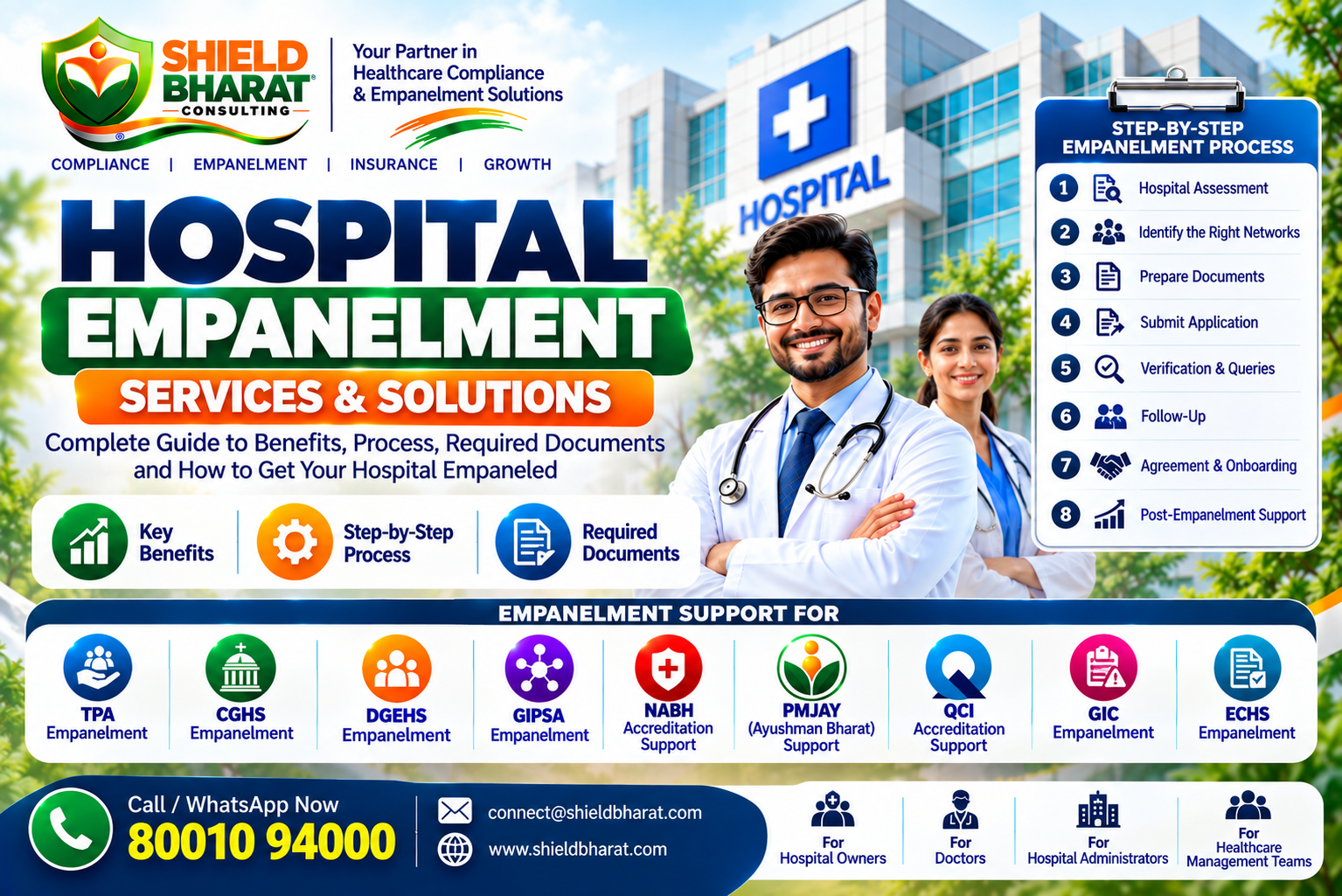
Hospital Empanelment: Why It Matters for Hospitals in India
Running a successful hospital requires much more than having qualified doctors, modern infrastructure and good patient care. Hospitals also need an effective system for handling insurance relationships, cashless treatment processes, third-party administrators, government healthcare schemes and healthcare compliance.
This is where hospital empanelment becomes important.
Hospital empanelment is the process through which a hospital becomes part of an insurer, TPA, government healthcare scheme or other healthcare network, subject to that organization's eligibility requirements, documentation, agreements and approval process.
For eligible insured patients, being part of an appropriate network can make cashless treatment access easier, subject to the patient's policy terms, authorization and applicable conditions. IRDAI-hosted policy documents describe network hospitals and cashless processes involving insurers and TPAs. IRDAI
However, hospital empanelment is not simply about filling out an application form.
It can involve:
- Hospital registration and legal documentation
- Infrastructure information
- Doctor and consultant details
- Statutory compliance
- Tariff and package information
- Insurance/TPA applications
- Verification
- Query resolution
- Follow-up
- Agreements and onboarding
- Ongoing updates and compliance
A hospital that approaches empanelment without preparation can face unnecessary delays, repeated document requests and administrative problems.
This is why professional guidance can be valuable.
Shield Bharat Consulting provides hospital empanelment and healthcare compliance support across areas including TPA, insurance, GIC/GIPSA, PMJAY, ECHS, CGHS, NABH, NABL, QCI and ROHINI-related services. Shield Bharat Consulting Pvt. Ltd.
What Is Hospital Empanelment?
Hospital empanelment means getting a healthcare facility approved or onboarded into a particular healthcare, insurance or government network.
Depending on the objective, a hospital may seek:
1. TPA Empanelment
TPA stands for Third Party Administrator.
TPAs perform health-insurance-related administrative functions for insurers. Hospitals may seek to become part of TPA-managed provider networks so that eligible insured patients can access applicable cashless facilities.
2. Insurance Company Empanelment
A hospital may establish a network relationship directly with an insurance company according to that insurer's requirements and commercial terms.
3. GIC / GIPSA Empanelment
Hospitals may also explore empanelment routes associated with general insurers and GIPSA-related networks. The precise process and current requirements should be verified before applying because network arrangements and processes can change. Shield Bharat Consulting Pvt. Ltd.
4. Government Healthcare Empanelment
Depending on eligibility and location, hospitals may explore schemes or networks such as:
- CGHS
- ECHS
- AB-PMJAY
- DGHS
- ESIC
- Other applicable government healthcare programs
5. Accreditation-Related Support
Hospitals may also need quality and accreditation support such as:
- NABH
- Pre-NABH / Entry Level
- NABL, where applicable
- QCI-related certification
These are different processes from insurance empanelment, but accreditation and compliance can be relevant to hospital network participation and eligibility.
Why Is Hospital Empanelment Important?
1. Access to Insured Patients
One of the biggest reasons hospitals pursue empanelment is to become accessible to patients covered by health insurance or healthcare schemes.
Patients frequently consider insurance acceptance when choosing a hospital.
A hospital may have excellent doctors and facilities, but if a patient's applicable insurance arrangement does not work there, the patient may choose another network facility.
Therefore, a well-planned insurance network can become an important part of a hospital's patient-access strategy.
2. Supporting Cashless Treatment
Cashless treatment is one of the major reasons hospitals and patients pay attention to network status.
Under applicable arrangements, eligible treatment at a network hospital can be processed through the insurer/TPA mechanism rather than requiring the patient to pay the entire eligible amount upfront.
However, cashless does not mean automatic approval of every expense.
Authorization, policy coverage, exclusions, deductibles, co-payments, medical necessity, documentation and other applicable conditions can affect the claim.
IRDAI-hosted policy documentation describes cashless treatment at network hospitals as subject to specified formalities and policy terms. IRDAI
Hospitals should therefore avoid promising patients that every treatment or expense will automatically be approved.
3. Improved Patient Convenience
Insurance can be confusing for patients and their families.
During hospitalization, they may need assistance with:
- Insurance verification
- Pre-authorization
- Required documents
- TPA communication
- Claim-related documentation
- Discharge formalities
A properly organized hospital insurance desk can make the administrative side of the patient's experience more manageable.
The goal is not merely to obtain empanelment but to have the internal processes required to operate the network effectively.
4. Wider Healthcare Network
Empanelment can help a hospital build relationships with:
- TPAs
- Insurance companies
- Public-sector insurance networks
- Government healthcare schemes
- Corporate healthcare programs
- Other healthcare payer networks
The right combination depends on the hospital's location, specialties, patient demographics, pricing and operational capabilities.
More empanelments are not automatically better.
A hospital should focus on relevant and sustainable networks, rather than simply trying to collect the largest possible number of approvals.
5. Better Business Planning
Insurance empanelment can become part of a hospital's broader business-development strategy.
Hospitals can evaluate:
Patient Demand + Specialty Strength + Insurance Network + Pricing + Clinical Capacity + Operational Readiness
This approach is much more useful than treating empanelment as a standalone administrative activity.
6. Stronger Institutional Credibility
Participation in established healthcare networks can contribute to a hospital's institutional positioning.
However, hospitals should be clear about what empanelment does and does not mean.
Empanelment is not a replacement for clinical quality.
A hospital still needs:
- Qualified doctors
- Proper nursing staff
- Appropriate infrastructure
- Patient safety systems
- Medical records
- Compliance
- Ethical practices
- Quality healthcare
Empanelment is one part of the overall hospital ecosystem.
TPA Empanelment vs Insurance Empanelment
These terms are often used interchangeably, but hospitals should understand the distinction.
A hospital can have relationships with:
Insurance Companies → TPAs → Government Schemes → Public-Sector Networks → Corporate Healthcare Programs
A TPA may administer claims or related functions on behalf of an insurer, but the TPA does not simply become the insurer.
Before entering any arrangement, hospital management should understand:
- Who is the insurer?
- Who is the TPA?
- What is the agreement?
- What are the applicable packages?
- What are the tariffs?
- How does authorization work?
- What documents are required?
- Who makes claim decisions?
- What are the payment terms?
This clarity prevents operational confusion.
Basic Documents Required for Hospital Empanelment
The exact documents vary by insurer, TPA, government scheme and hospital type.
Therefore, the following should be treated as a general preparation checklist, not a universal mandatory list.
A. Hospital Legal Documents
Hospitals may commonly need:
- Hospital registration certificate
- Ownership documents
- PAN
- GST registration, where applicable
- Incorporation/constitution documents
- Address proof
- Authorized signatory documents
- Applicable licenses
B. Hospital Profile
A comprehensive hospital profile may include:
- Hospital name
- Complete address
- Contact information
- Establishment details
- Total bed capacity
- ICU beds
- Emergency facilities
- Operation theatres
- Specialties
- Departments
- 24×7 services
- Diagnostic facilities
- Pharmacy
- Ambulance services
- Other available facilities
C. Doctor and Consultant Documents
Depending on the organization, hospitals may need:
- Doctor list
- Consultant list
- Medical registration numbers
- Qualification certificates
- Specialist details
- Appointment/engagement information
- Nursing staff information
- Other healthcare professional details
For government empanelment and accreditation processes, more detailed staffing and qualification documentation may be required.
D. Infrastructure Documents
Hospitals should maintain accurate information regarding:
- Bed strength
- ICU
- Operation theatres
- Emergency department
- Diagnostic facilities
- Laboratory
- Imaging facilities
- Pharmacy
- Blood bank, where applicable
- Ambulance
- Medical equipment
- Specialty-specific equipment
E. Statutory and Compliance Documents
Depending on the facility and jurisdiction, hospitals may require documents relating to:
- Fire safety
- Biomedical waste
- Pollution control
- Pharmacy
- Radiology/AERB, where applicable
- Blood bank, where applicable
- Clinical establishment registration
- Other applicable statutory permissions
The exact requirements depend on the hospital, state and service profile.
F. Financial and Banking Documents
Hospitals may commonly be asked for:
- Bank account details
- Cancelled cheque
- IFSC details
- PAN
- GST details, where applicable
- Tariff sheet
- Package rates
- Billing information
- Other financial documents requested by the network
G. Accreditation and Quality Documents
Where available and applicable, hospitals should maintain:
- NABH certificate
- NABH Entry Level / Pre-Accreditation documents
- NABL documentation for laboratories
- ISO certification
- QCI-related documents
- Other recognized quality certifications
Accreditation requirements differ by scheme and organization.
H. ROHINI Registration
ROHINI refers to the Registry of Hospitals in Network of Insurance.
Some insurer/TPA empanelment processes may require or strongly rely on a valid ROHINI registration/ID.
Current industry requirements can vary, so hospitals should confirm the exact requirement with the relevant insurer, TPA or network before submitting an application. Shield Bharat Consulting also lists ROHINI-related support among its hospital empanelment services. Shield Bharat Consulting Pvt. Ltd.
Step-by-Step Hospital Empanelment Process
Although every organization has its own process, hospitals can generally think of empanelment in the following stages.
Step 1: Hospital Assessment
First, evaluate the hospital.
Review:
- Infrastructure
- Beds
- Specialties
- Doctors
- Licenses
- Compliance
- Accreditation
- Existing insurance panels
- Tariff
- Documentation
This identifies gaps before an application is submitted.
Step 2: Identify the Right Networks
Do not randomly apply everywhere.
Identify networks that make commercial and operational sense for your hospital.
Consider:
- Local demand
- Patient profile
- Specialty
- Hospital location
- Existing network coverage
- Treatment categories
- Tariff
- Operational capacity
A hospital in a metropolitan city may need a different strategy from a hospital in a smaller city.
Step 3: Prepare the Master Document File
Create one central digital repository containing:
- Legal documents
- Registrations
- Licenses
- Doctor details
- Staff details
- Infrastructure
- Equipment
- Bank documents
- Tariff
- Accreditation
- Compliance documents
Then create network-specific versions when required.
This is far more efficient than repeatedly searching for documents whenever an insurer asks for them.
Step 4: Prepare Tariff and Package Information
Tariff preparation is one of the areas hospitals should take seriously.
A tariff should reflect:
- Hospital costs
- Doctor charges
- Nursing
- Room categories
- OT
- ICU
- Diagnostics
- Consumables
- Packages
- Specialty procedures
Do not blindly copy another hospital's pricing.
A tariff that looks attractive but is financially unsustainable can create problems after empanelment.
Step 5: Submit the Application
Once the documentation is ready, the application can be submitted according to the relevant insurer, TPA, scheme or network process.
Depending on the organization, submission may involve:
- Online portal
- Physical documents
- Digital uploads
- Authorized forms
- Supporting certificates
The process is organization-specific.
Step 6: Verification and Queries
After submission, the organization may:
- Review documents
- Request clarification
- Ask for additional documents
- Conduct verification
- Review infrastructure
- Evaluate hospital tariffs
- Check accreditation
- Ask operational questions
This stage is where incomplete applications often create delays.
Step 7: Follow-Up
A submitted application should be tracked.
Maintain a record of:
| Item | Status |
|---|---|
| Application | Submitted / Pending |
| Documents | Complete / Query |
| Verification | Pending / Completed |
| Tariff | Submitted / Negotiation |
| Agreement | Pending / Completed |
| Empanelment | Approved / Pending |
This simple system can prevent applications from being forgotten.
Step 8: Agreement and Onboarding
If approved, the hospital may need to complete:
- Agreement/MOU
- Rate confirmation
- Bank verification
- Network onboarding
- Portal access
- Insurance desk setup
- Communication procedures
The exact requirements depend on the network.
Step 9: Prepare the Hospital Insurance Desk
Getting empaneled is only the beginning.
Your team should understand:
- Insurance verification
- Pre-authorization
- Required documentation
- TPA communication
- Discharge documentation
- Claim submission
- Query handling
- Deduction management
- Escalation procedures
A hospital can get empaneled and still perform poorly if its internal insurance process is weak.
Step 10: Maintain the Empanelment
Keep documents current.
Monitor:
- License expiry
- Doctor changes
- Address changes
- Bank details
- Tariffs
- Accreditation
- Hospital infrastructure
- Insurance agreements
- Network updates
Empanelment should be treated as an ongoing management function, not a one-time activity.
Common Mistakes Hospitals Make
1. Applying Without Document Preparation
This causes repeated queries and delays.
2. Using Expired Documents
An expired license can create serious problems.
3. Not Maintaining a Master Database
Teams waste time repeatedly collecting the same information.
4. Applying to Every Network
More panels do not automatically mean more profit.
5. Ignoring Tariff Economics
An unprofitable package can hurt the hospital after empanelment.
6. Poor Follow-Up
Applications can remain pending because nobody owns the process.
7. Weak Insurance Desk
Approval does not guarantee smooth operations.
8. Promising Cashless Approval to Patients
Cashless authorization depends on applicable policy, network and authorization conditions.
9. Treating Accreditation as Optional in Every Situation
Requirements vary, but accreditation can be important for some schemes and can strengthen a hospital's quality systems and positioning.
How Professional Hospital Empanelment Services Can Help
Hospital management teams are already responsible for:
- Patients
- Doctors
- Staff
- Billing
- Operations
- Compliance
- Pharmacy
- Diagnostics
- Vendors
- Finance
Adding multiple empanelment applications can become a significant administrative burden.
A professional consultant can help organize the process through:
Hospital Assessment
Reviewing current readiness.
Documentation
Preparing a structured document checklist.
Application Assistance
Helping organize application information.
Coordination
Supporting communication with relevant organizations.
Follow-Up
Tracking pending applications and queries.
Compliance Guidance
Identifying documentation and process gaps.
Accreditation Support
Supporting hospitals with relevant accreditation preparation.
Post-Empanelment Support
Helping hospitals organize their ongoing network requirements.
The consultant does not replace the insurer, TPA, government authority or accreditation body. Final approval remains with the relevant organization.
Why Choose Shield Bharat Consulting?
Shield Bharat Consulting focuses on hospital empanelment, insurance networks and healthcare compliance support.
Its listed services include:
- TPA Empanelment
- Insurance Empanelment
- GIC Empanelment
- GIPSA Empanelment
- AB-PMJAY
- ECHS
- CGHS
- DGHS
- ESIC
- NABH
- Pre-NABH
- NABL
- QCI
- ROHINI-related support
The company states that it provides end-to-end hospital empanelment and compliance support across India. Shield Bharat Consulting Pvt. Ltd.
The practical advantage is having one structured process.
Instead of handling every application separately, a hospital can build a central documentation and compliance system and then use that foundation for relevant empanelment opportunities.
Who Can Use Hospital Empanelment Services?
Professional empanelment support can be relevant for:
- New hospitals
- Existing hospitals
- Multi-specialty hospitals
- Specialty hospitals
- Nursing homes
- Healthcare groups
- Hospital chains
- Clinics, where applicable
- Diagnostic centres, where applicable
- Hospital administrators
- Medical directors
- Hospital owners
- Insurance desk managers
Eligibility depends on the particular network or scheme.
Hospital Empanelment Should Be Viewed as a Long-Term Strategy
The wrong mindset is:
“We just need an empanelment certificate.”
The better mindset is:
“We need a sustainable healthcare network that our hospital can operate profitably and compliantly.”
That means looking at the entire chain:
Hospital Readiness → Documentation → Compliance → Application → Verification → Empanelment → Insurance Desk → Cashless Operations → Claims → Follow-Up → Renewal
Every part matters.
Final Checklist Before Starting Your Empanelment
Before contacting an insurer or TPA, review these areas:
Hospital
☐ Registration completed
☐ Hospital profile prepared
☐ Bed details available
☐ Specialty list ready
☐ Infrastructure details prepared
Doctors & Staff
☐ Doctor list
☐ Registration numbers
☐ Qualification details
☐ Nursing/staff details
Compliance
☐ Fire safety
☐ Biomedical waste
☐ Pollution control
☐ Applicable clinical registrations
☐ Applicable equipment registrations
Financial
☐ PAN
☐ GST, where applicable
☐ Bank details
☐ Cancelled cheque
☐ Tariff sheet
☐ Package rates
Quality
☐ NABH documentation, if applicable
☐ NABL documentation, if applicable
☐ QCI/other certification, if applicable
Insurance
☐ ROHINI status checked
☐ Target TPAs identified
☐ Target insurers identified
☐ GIC/GIPSA opportunities evaluated
☐ Government schemes evaluated
Operations
☐ Insurance desk identified
☐ Staff responsibilities assigned
☐ Pre-authorization process planned
☐ Claim documentation process planned
Need Professional Help With Hospital Empanelment?
If you are a hospital owner, doctor, medical director, hospital administrator or healthcare management professional, you do not need to navigate every empanelment process blindly.
The smarter approach is to first assess your hospital's readiness, identify the right networks, prepare the required documentation and then proceed with a structured application and follow-up process.
Shield Bharat Consulting can guide hospitals through relevant TPA, insurance, GIC, GIPSA, CGHS, ECHS, PMJAY, NABH, NABL, QCI and other healthcare empanelment/compliance processes, depending on the hospital's requirements and eligibility. Shield Bharat Consulting Pvt. Ltd.
Connect With Shield Bharat Consulting
📞 Call / WhatsApp: 80010 94000
📧 Email: connect@shieldbharat.com
🌐 Website: Shield Bharat Consulting
Shield Bharat Consulting
Your Partner in Healthcare Compliance & Empanelment Solutions
Important: Empanelment requirements, tariffs, agreements, accreditation criteria, cashless procedures and approval decisions vary by insurer, TPA, government scheme and applicable regulations. Empanelment support does not guarantee approval, patient volume, cashless authorization, claim settlement or revenue. Always verify current requirements with the relevant authority/network before submitting an application.