
In today’s healthcare environment, hospitals are not only expected to provide quality medical treatment; they also need to build efficient relationships with insurance companies, Third Party Administrators (TPAs), government-linked healthcare networks and other payer ecosystems.
For many hospitals, TPA empanelment and insurance empanelment can be an important part of building access to insured patients and participating in cashless healthcare arrangements. In network-hospital models, eligible treatment expenses can be handled through a cashless process subject to the applicable insurance policy, authorization requirements, hospital terms and other conditions. IRDAI-hosted policy documents describe network hospitals as healthcare providers enlisted by an insurer or by an insurer and TPA together to provide medical services through a cashless facility.
For hospital owners and administrators, the challenge is that empanelment is not simply about submitting one application. It can involve documentation, hospital information, infrastructure details, compliance requirements, rate-related discussions, coordination, queries, verification and continuing communication.
This is where professional hospital empanelment services can provide structured assistance.
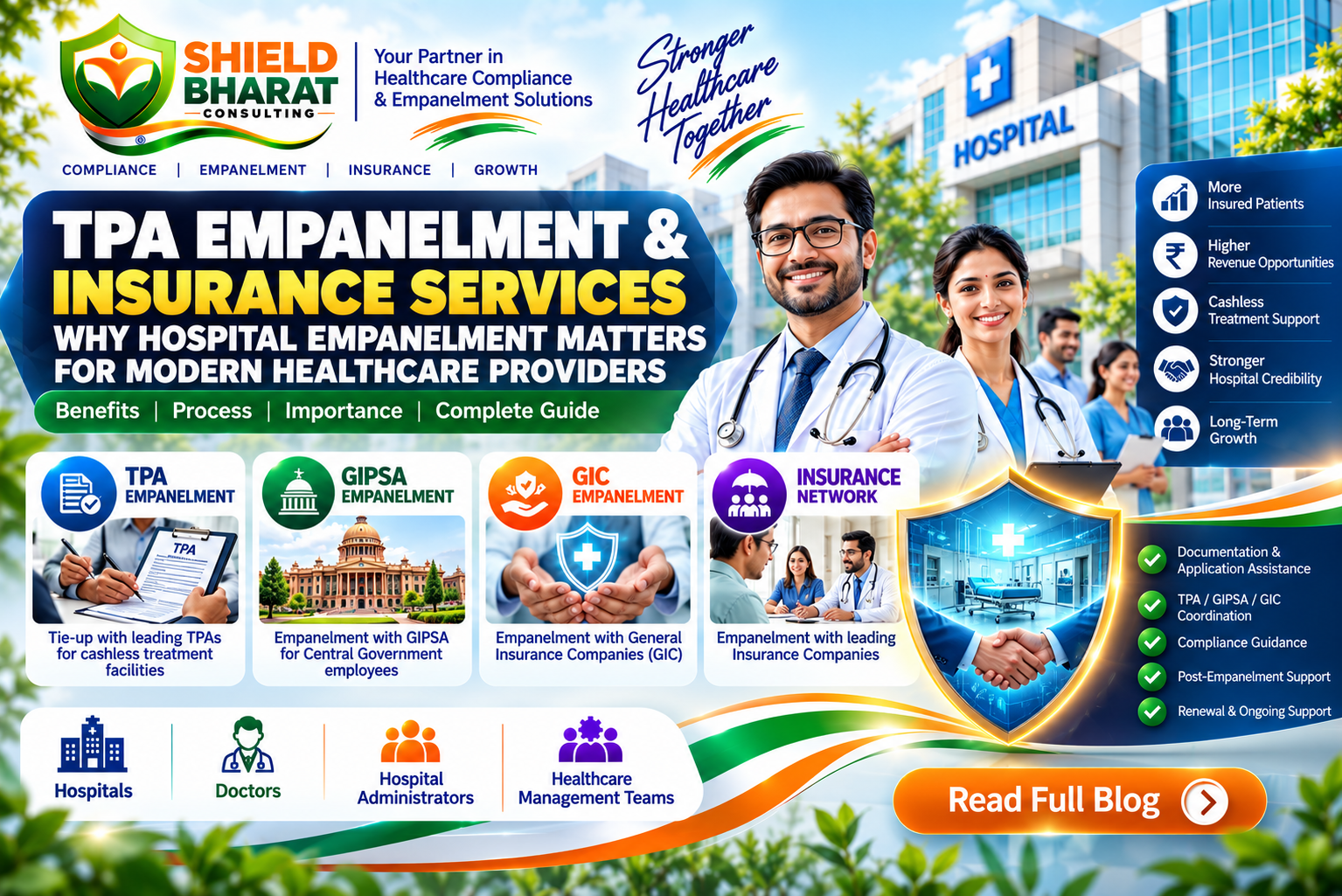
Hospital Empanelment & Insurance Solutions – Shield Bharat Consulting
What Is TPA Empanelment?
TPA empanelment refers to the process through which a hospital becomes part of a healthcare provider network associated with an insurer and/or Third Party Administrator.
A TPA is appointed by an insurer to provide administrative services on its behalf and at its direction.
Depending on the insurer and policy structure, a network hospital may participate in cashless treatment processes where eligible expenses are settled according to the applicable policy and authorization process. Some IRDAI-hosted policy documents specifically describe cashless facilities at network hospitals and direct settlement of eligible hospital bills through the insurer/TPA mechanism, subject to policy terms and required formalities.
For a hospital, being part of an appropriate network can therefore create an additional channel through which insured patients may access treatment.
However, hospital management should understand one important point:
Empanelment does not automatically mean that every treatment, claim or expense will be approved.
Coverage depends on the patient's policy, eligibility, treatment, authorization, exclusions, documentation, admissibility and other applicable conditions. IRDAI-hosted policy documents also show that pre-authorization and documentation can form part of cashless claim processes.
Why Is TPA Empanelment Important for Hospitals?
1. Access to Insured Patients
A major reason hospitals explore empanelment is to participate in insurance-linked healthcare networks.
Patients with health insurance may actively look for hospitals where their insurance or TPA arrangement can be used. Network status can therefore be relevant when patients are comparing healthcare providers.
For hospitals, this creates an opportunity to make their services accessible to a broader category of patients.
The exact benefit will vary according to location, specialty, insurer network, policy coverage, hospital capacity and other commercial and operational factors.
2. Supporting Cashless Treatment
One of the most visible advantages associated with network hospitals is the availability of cashless processes where applicable.
In a cashless arrangement, the patient generally does not have to pay the entire eligible hospitalization expense upfront, subject to authorization and the terms of the insurance policy.
IRDAI-hosted policy documents describe network-hospital cashless arrangements and the role of the TPA in authorization and claim administration.
For example, a typical process can involve:
Patient Admission → Insurance/TPA Verification → Cashless Request → Medical Documentation → Authorization → Treatment → Discharge Documentation → Claim Processing
The actual process can differ between insurers, TPAs and policies.
Therefore, hospitals need a team that understands documentation and communication requirements rather than assuming that every insurer follows exactly the same workflow.
3. Stronger Insurance Network Participation
Healthcare is increasingly connected with insurance ecosystems.
Hospitals may work with multiple categories of organizations, including:
- Health insurance companies
- General insurance companies
- TPAs
- GIPSA-related networks
- Government healthcare schemes
- Corporate healthcare programs
- Other healthcare payer networks
Managing these relationships manually can become complicated.
A structured insurance empanelment strategy can help hospitals organize applications, documentation, communication and follow-up across different networks.
4. Better Patient Convenience
For an insured patient, understanding whether a hospital is part of a relevant network can be an important consideration.
A hospital that participates in appropriate insurance networks may be able to provide a more structured insurance-desk experience for eligible patients.
This can involve:
- Insurance verification
- Pre-authorization coordination
- Required document collection
- Communication with the TPA
- Claim-related documentation
- Discharge coordination
- Query handling
The exact requirements depend on the insurer, TPA and policy.
5. Hospital Credibility and Professional Positioning
Insurance empanelment can also form part of a hospital's overall institutional positioning.
A hospital that maintains proper documentation, compliance systems, medical records and insurance coordination processes demonstrates organizational readiness.
But hospitals should avoid treating empanelment as a substitute for medical quality.
Clinical quality, patient safety, qualified medical professionals, infrastructure, ethical practices and regulatory compliance remain fundamental.
Empanelment should be considered one component of a hospital's broader operational and business strategy.
What Is Insurance Empanelment?
Insurance empanelment involves the process of getting a hospital recognized or onboarded within an insurer's healthcare provider network, subject to that organization's eligibility criteria and agreement.
The process may involve evaluation of:
- Hospital registration
- Ownership details
- Infrastructure
- Medical facilities
- Doctors and specialists
- Nursing staff
- Diagnostic facilities
- Bed capacity
- Licenses
- Certifications
- Hospital rates
- Documentation
- Quality and compliance requirements
Requirements are not identical across all insurers.
That is why hospitals should not use a generic application package for every organization without checking the specific requirements.
TPA Empanelment vs Insurance Empanelment
Although the terms are often used together, they are not necessarily identical.
TPA Empanelment
This generally relates to joining a network administered through a TPA arrangement associated with insurers.
Insurance Empanelment
This refers more broadly to establishing a hospital's network relationship with an insurance company.
GIC Empanelment
This can refer to empanelment-related processes involving General Insurance Companies.
GIPSA Empanelment
GIPSA-related empanelment can involve networks and arrangements associated with the participating public-sector general insurance ecosystem.
Each organization may have its own process, requirements, documentation and commercial terms.
Therefore, hospitals should verify the specific requirements before submitting applications.
What Documents May Be Required for Hospital Empanelment?
Documentation is one of the most important parts of the empanelment process.
Depending on the organization and type of empanelment, hospitals may be asked to provide documents such as:
Hospital Registration Documents
- Hospital registration certificate
- Ownership documents
- PAN
- GST details, where applicable
- Address proof
- Legal entity documents
Medical & Clinical Documents
- Doctor registration details
- Consultant information
- Nursing staff details
- Specialist details
- Qualification certificates
- Medical licenses
Infrastructure Details
- Number of beds
- ICU facilities
- Operation theatres
- Emergency services
- Diagnostic facilities
- Pharmacy
- Laboratory
- Ambulance facilities
- Other clinical infrastructure
Compliance Documents
- Applicable statutory registrations
- Fire safety documentation
- Biomedical waste-related compliance
- Pollution-related documentation, where applicable
- Other local/state requirements
Financial & Commercial Information
Depending on the network, hospitals may need to provide:
- Rate lists
- Package rates
- Bank details
- Billing information
- Financial documentation
- Tariff information
The exact list should always be confirmed with the relevant organization.
Why Documentation Matters
A common mistake is treating documentation as paperwork that can be completed at the last minute.
That approach can create avoidable delays.
Incomplete documentation can lead to:
- Queries
- Re-submission
- Additional clarification
- Delayed processing
- Verification issues
- Communication gaps
A structured documentation process can reduce unnecessary back-and-forth.
This is one reason hospitals often consider professional hospital empanelment consultants or dedicated internal empanelment teams.
The Role of Hospital Empanelment Consultants
A professional empanelment consultant does not replace the insurer, TPA or regulatory authority.
Instead, the consultant can assist the hospital with process management.
Typical assistance may include:
1. Requirement Assessment
Understanding the hospital's current infrastructure, documentation and service profile.
2. Document Checklist
Preparing an organization-specific checklist.
3. Application Assistance
Helping organize and prepare the information required for submission.
4. Coordination
Supporting communication between the hospital and relevant payer/network organizations.
5. Query Management
Helping the hospital understand and respond to documentation or process-related queries.
6. Follow-Up
Tracking the status of applications and pending requirements.
7. Post-Empanelment Assistance
Supporting communication and documentation after onboarding.
The exact scope depends on the service agreement between the hospital and consultant.
Why Hospitals Should Not Ignore Insurance Network Management
Some hospitals focus heavily on patient acquisition through advertising, digital marketing and referrals while underestimating payer-network management.
That can be a mistake.
A hospital may invest significantly in:
- Doctors
- Equipment
- Infrastructure
- Digital marketing
- Branding
- Patient acquisition
But if its insurance-network strategy is weak, it may fail to capture opportunities from insured patients who require network-based treatment.
This does not mean every hospital needs every insurance network.
Instead, hospital management should identify the networks that are relevant to its:
- Location
- Specialty
- Patient demographics
- Treatment categories
- Pricing
- Infrastructure
- Business strategy
TPA Empanelment for Multi-Specialty Hospitals
Multi-specialty hospitals can have particularly diverse requirements.
For example, a hospital may offer:
- Cardiology
- Orthopedics
- General Surgery
- Gynecology
- Pediatrics
- Neurology
- Gastroenterology
- Urology
- Oncology
- Critical Care
Insurance networks may have different requirements for different treatments, packages and specialties.
Therefore, hospital administrators need accurate documentation and a clear understanding of the hospital's capabilities.
TPA Empanelment for Specialty Hospitals
Specialty hospitals should also evaluate empanelment strategically.
For example:
Orthopedic Hospital
May focus on networks relevant to joint replacement, trauma, orthopedic procedures and rehabilitation.
Cardiac Hospital
May focus on insurance networks relevant to cardiac procedures and hospitalization.
Maternity Hospital
May evaluate networks relevant to maternity and women's healthcare.
Eye Hospital
May explore networks relevant to ophthalmology and day-care procedures.
The right network mix depends on the hospital's business model and patient population.
Insurance Services for Hospitals
Hospital insurance services can go beyond initial empanelment.
A hospital may need ongoing assistance with:
- Insurance coordination
- TPA communication
- Documentation
- Authorization-related communication
- Claim documentation
- Query resolution
- Network updates
- Renewal-related processes
- Rate discussions
- Hospital profile updates
The operational workload can become significant as the number of payer relationships increases.
Importance of Pre-Authorization
Pre-authorization is an important component of many cashless treatment workflows.
IRDAI-hosted policy documentation describes processes where the TPA receives a cashless request and relevant medical information and issues a pre-authorization decision after verification.
Hospitals therefore need to ensure that their insurance desk understands:
- Patient insurance details
- Policy information
- Required forms
- Medical documentation
- Diagnosis
- Treatment plan
- Estimated cost
- Required authorization information
Incorrect or incomplete information can create delays or additional queries.
Importance of Accurate Medical Documentation
Insurance-related processes depend heavily on documentation.
Hospitals should maintain accurate:
- Admission records
- Diagnosis records
- Investigation reports
- Treatment notes
- Doctor notes
- Procedure details
- Medication records
- Discharge summaries
- Bills
- Receipts
- Other required supporting documents
IRDAI-hosted policy documents illustrate the importance of claim forms, medical records, bills, discharge documents and other supporting evidence in claim processing.
Good documentation is not merely an insurance requirement.
It is part of good hospital administration.
Cashless Does Not Mean Every Expense Is Covered
This is an important point for hospital administrators.
A patient being admitted to a network hospital does not automatically mean that every expense will be paid by the insurer.
Coverage can depend on:
- Policy terms
- Sum insured
- Eligibility
- Waiting periods
- Exclusions
- Deductibles
- Co-payments
- Non-medical expenses
- Treatment eligibility
- Authorization
- Documentation
- Other policy conditions
IRDAI-hosted policy documents also distinguish eligible and inadmissible/non-medical expenses in cashless processes.
Hospitals should communicate clearly with patients about applicable requirements and avoid making guarantees that are outside the hospital's control.
How Empanelment Can Support Hospital Growth
Hospital growth is not driven by empanelment alone.
However, empanelment can become one component of a broader growth strategy.
A hospital may combine:
Clinical Excellence + Patient Experience + Digital Presence + Doctor Network + Insurance Network + Operational Efficiency
This creates a more comprehensive healthcare business model.
For example, a hospital may improve its digital visibility but still lose potential patients if insured patients cannot easily understand its insurance options.
Likewise, having insurance relationships without strong patient service can create operational problems.
The goal should be to build an integrated system.
Why Professional Support Can Save Administrative Time
Hospital administrators already manage:
- Staff
- Doctors
- Patients
- Billing
- Pharmacy
- Diagnostics
- Compliance
- Vendors
- Operations
- Finance
Adding multiple empanelment applications can create another administrative burden.
Professional support can help organize the process into defined stages:
Assessment → Documentation → Application → Submission → Coordination → Query Resolution → Follow-Up → Empanelment → Ongoing Support
This structured approach can make the workflow easier to manage.
Shield Bharat Consulting – Hospital Empanelment & Insurance Solutions
Shield Bharat Consulting provides healthcare empanelment and insurance-related support for hospitals and healthcare organizations.
The focus includes:
TPA Empanelment
Assistance with TPA-related hospital network empanelment processes.
GIPSA Empanelment
Support with GIPSA-related empanelment requirements and coordination.
GIC Empanelment
Assistance related to General Insurance Company empanelment.
Insurance Empanelment
Support for hospitals looking to establish relationships with relevant insurance networks.
Documentation Support
Assistance in organizing required hospital information and documentation.
Application Assistance
Support in preparing and coordinating application submissions.
Follow-Up Support
Assistance with tracking pending queries and process-related communication.
Compliance Guidance
Support in understanding documentation and process requirements relevant to empanelment.
Post-Empanelment Support
Continued assistance after onboarding, depending on the agreed service scope.
Learn more about the services through:
Shield Bharat Consulting – Hospital Empanelment Services
Who Can Benefit From Hospital Empanelment Services?
These services may be relevant to:
- Multi-specialty hospitals
- Specialty hospitals
- Nursing homes
- Day-care centers
- Diagnostic centers, where applicable
- Healthcare groups
- Hospital chains
- New hospitals
- Established hospitals
- Hospital administrators
- Healthcare management companies
Eligibility and empanelment requirements vary by network and organization.
New Hospitals and Empanelment
For a new hospital, empanelment planning should ideally begin alongside operational planning.
The hospital should consider:
- Required registrations
- Infrastructure documentation
- Doctor credentials
- Staff records
- Hospital tariff
- Billing systems
- Insurance desk
- Patient documentation
- Medical records
- Compliance processes
Trying to build the entire empanelment system after patient operations have already started can create unnecessary pressure.
Established Hospitals and Network Expansion
Existing hospitals can also periodically review their current payer network.
Questions worth asking include:
- Which insurance networks are currently active?
- Which applications are pending?
- Which agreements require renewal?
- Are hospital details updated?
- Are doctor credentials current?
- Are tariff details updated?
- Are insurance desk processes documented?
- Are pending queries being tracked?
- Are patient complaints related to insurance being monitored?
A structured review can help management identify administrative gaps.
TPA Empanelment Is a Process, Not a One-Time Marketing Activity
One of the biggest misconceptions is that empanelment ends once a hospital receives approval.
In reality, healthcare network relationships require ongoing management.
Hospitals may need to manage:
- Changes in doctors
- Changes in infrastructure
- Updated licenses
- Revised tariffs
- New services
- Renewals
- Network communications
- Claim-related queries
- Documentation updates
- Compliance requirements
Therefore, hospitals should treat empanelment as an ongoing operational function.
Building a Dedicated Insurance Desk
Hospitals serious about insurance business should consider having trained personnel responsible for:
Patient Insurance Verification
Checking the available policy and network information.
TPA Coordination
Communicating with relevant TPA teams.
Pre-Authorization
Preparing and submitting required information.
Documentation
Maintaining complete records.
Discharge Coordination
Ensuring required documents are properly completed.
Query Handling
Responding to payer/TPA queries.
Claim Coordination
Supporting required claim documentation and communication.
A dedicated insurance desk can improve process ownership within the hospital.
Technology and Hospital Empanelment
Technology can also improve insurance administration.
Hospitals can use digital systems for:
- Document management
- Application tracking
- Query tracking
- Patient insurance verification
- TPA communication records
- Renewal reminders
- Hospital profile management
- Reporting
- Claim documentation
A centralized system can reduce dependency on scattered spreadsheets, emails and paper files.
Common Mistakes Hospitals Should Avoid
Mistake 1: Submitting Incomplete Documents
Incomplete applications create unnecessary queries.
Mistake 2: Using the Same Information Everywhere
Different insurers may require different formats or documentation.
Mistake 3: Ignoring Follow-Up
Submitting an application is not the end of the process.
Mistake 4: Not Updating Hospital Information
Changes in doctors, infrastructure, services or legal details may need to be communicated.
Mistake 5: Making Patient Promises
Hospital staff should not promise that an insurer will definitely approve a claim.
Mistake 6: Ignoring Compliance
Insurance empanelment should not be treated separately from hospital compliance.
Mistake 7: Focusing Only on Quantity
Getting connected with a large number of networks is not automatically useful if the networks do not match the hospital's patient profile or operational capacity.
A Better Strategy for Hospital Empanelment
Instead of asking:
“How many TPAs can we get empaneled with?”
Hospital management should ask:
“Which payer networks are relevant to our hospital, specialties and patients?”
Then build a structured plan.
Step 1: Hospital Assessment
Review hospital infrastructure, specialties, documentation and compliance.
Step 2: Network Identification
Identify relevant TPA, GIPSA, GIC and insurance opportunities.
Step 3: Documentation
Create an organized document repository.
Step 4: Application
Prepare applications according to specific requirements.
Step 5: Coordination
Maintain communication with relevant organizations.
Step 6: Query Resolution
Respond to requirements and clarifications.
Step 7: Follow-Up
Track pending applications.
Step 8: Empanelment
Complete the required onboarding process.
Step 9: Post-Empanelment
Maintain documentation and communication.
Step 10: Review
Periodically evaluate network performance and relevance.
TPA and Insurance Empanelment: A Long-Term Hospital Strategy
Hospitals should look beyond immediate admissions.
A strong insurance network strategy can become part of the hospital's long-term operational planning.
The objective should be to create a system where:
Patients → Hospital → Insurance/TPA → Documentation → Authorization → Treatment → Discharge → Claim Process
works with clear responsibilities at each stage.
This requires coordination between:
- Doctors
- Nurses
- Billing teams
- Insurance desk
- Medical records
- Administration
- Finance
- Hospital management
Empanelment therefore affects more than the business-development department.
Final Thoughts
TPA empanelment and insurance empanelment are important considerations for hospitals operating in an increasingly insurance-linked healthcare environment.
Network participation can support access to insured patients and cashless processes where applicable, but hospitals should understand that coverage and claim settlement remain subject to policy terms, authorization, documentation and other applicable conditions.
The real value of professional empanelment support is not simply submitting forms.
It is about creating a structured process for:
Documentation + Application + Coordination + Follow-Up + Compliance + Post-Empanelment Support
For hospitals looking to explore TPA, GIPSA, GIC and insurance empanelment, the first step should be a clear assessment of their current documentation, infrastructure, specialties, compliance status and target insurance networks.
Shield Bharat Consulting provides empanelment and insurance-related support designed to help hospitals organize and navigate these processes.
👉 Explore Hospital Empanelment & Insurance Services:
https://shieldbharat.com – Shield Bharat Consulting
📞 Contact Shield Bharat Consulting
Call / WhatsApp: 80010 94000
Email: connect@shieldbharat.com
Website: shieldbharat.com
Shield Bharat Consulting
Your Partner in Healthcare Compliance & Empanelment Solutions