
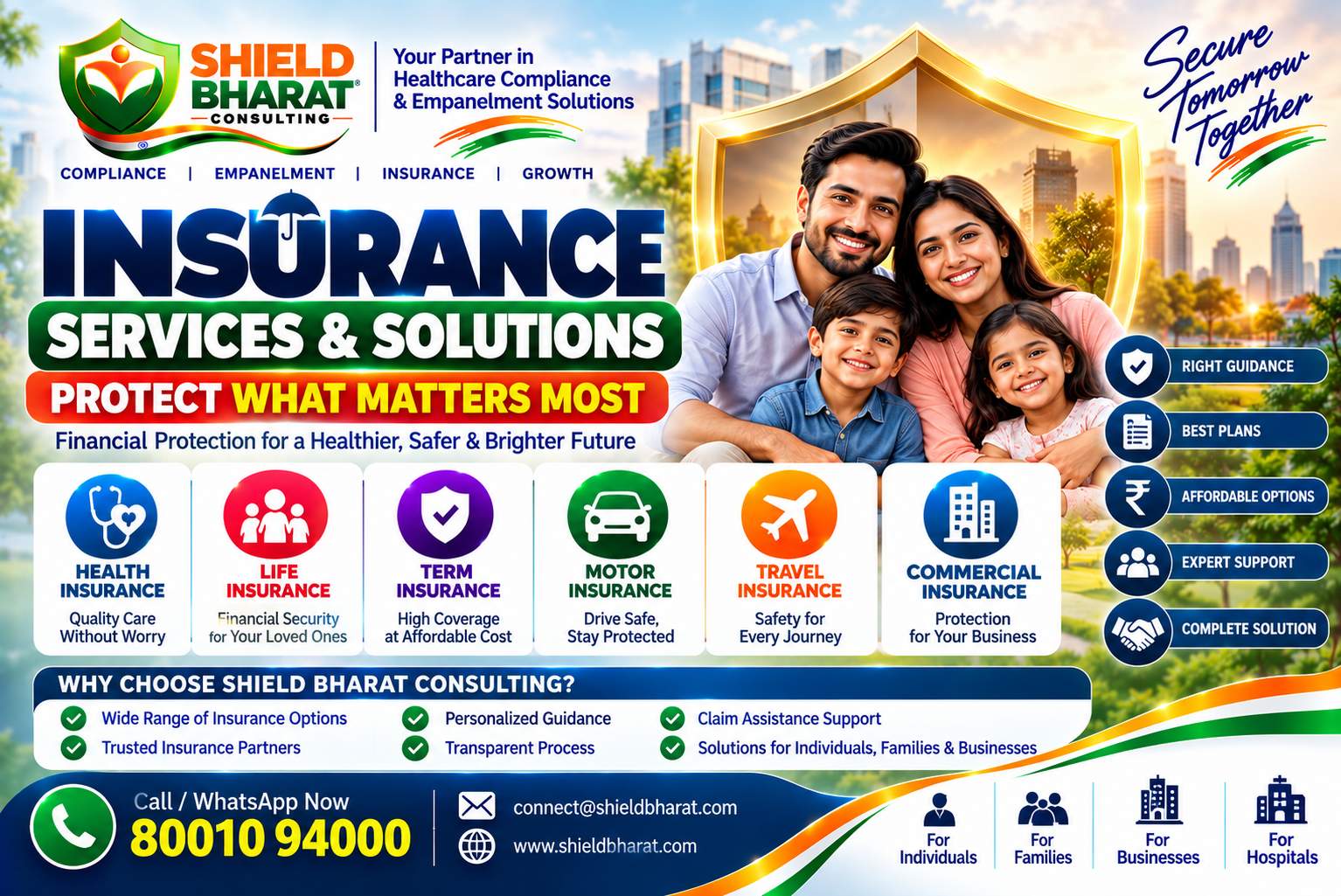
In an unpredictable world, insurance plays an important role in protecting individuals, families and businesses against financial risks. Medical emergencies, accidents, unexpected loss of income, vehicle damage and business liabilities can create significant financial pressure. The right insurance policy can help manage eligible losses and provide financial support when unexpected events occur.
However, choosing insurance is not simply about finding the lowest premium. It requires understanding coverage, exclusions, waiting periods, deductibles, policy limits, claim procedures and the specific risks that need protection.
Shield Bharat Consulting provides insurance-related guidance and solutions for individuals, families, businesses and healthcare organizations. Its services include health insurance, life insurance, term insurance, motor insurance, travel insurance and hospital empanelment support.
Whether you are looking for family health coverage, financial protection for dependents, vehicle insurance or business insurance solutions, understanding the available options is the first step towards making an informed decision.
Explore Insurance Services & Solutions by Shield Bharat Consulting to learn more about available services and request assistance.
Quick Answer: What Are Insurance Services & Solutions?
Insurance services and solutions help individuals, families and businesses identify, compare and obtain insurance coverage suited to their financial circumstances and protection needs.
Common insurance categories include:
Health insurance: Helps cover eligible medical expenses according to policy terms.
Life insurance: Provides a specified benefit under the policy when a covered event occurs.
Term insurance: Provides life cover for a defined period.
Motor insurance: Provides specified protection for vehicles, subject to the policy.
Travel insurance: Can cover eligible medical emergencies and other travel-related risks.
Commercial insurance: Helps businesses manage specified property, liability and operational risks.
The right policy depends on your needs, budget, eligibility, insurer's terms and the risks you want to protect against.
1. Why Are Insurance Services Important?
Insurance is a financial risk-management tool. Instead of bearing the full financial impact of every covered event yourself, you transfer specified risks to an insurer in exchange for a premium, subject to the policy's terms and conditions.
Financial protection against unexpected expenses
A medical emergency, serious accident or unexpected death in a family can affect savings, investments and long-term financial plans.
Suitable insurance coverage can help reduce the financial impact of covered events.
Protecting family members
Life and health insurance can be important components of family financial planning. Depending on the policy, they may help cover medical expenses or provide financial benefits to beneficiaries.
Protecting assets
Motor and property-related insurance products can provide protection against specified losses involving vehicles or other insured assets.
Supporting business continuity
Businesses may face risks involving property damage, liability, employees, vehicles and interruptions to operations. Appropriate commercial insurance can help manage some of these risks.
Better financial planning
Insurance can complement savings, emergency funds and investments. It should not be treated as a replacement for all other financial planning.
The objective is to select coverage that addresses genuine risks without paying for unnecessary benefits.
2. Health Insurance Services and Solutions
Health insurance helps cover eligible healthcare expenses according to the selected policy. Depending on the product, coverage may include hospitalization, surgeries, specified day-care procedures and other covered medical expenses.
Medical costs can be unpredictable, making health insurance an important consideration for individuals and families.
Benefits of health insurance
Financial support for eligible hospitalization expenses.
Coverage for specified medical procedures.
Access to network hospitals and cashless treatment where applicable.
Individual and family-floater policy options.
Potential access to specified additional benefits, depending on the product.
Types of health insurance
Individual health insurance: Provides coverage for a person under an individual policy.
Family-floater health insurance: Provides a shared sum insured for covered family members under the policy.
Senior-citizen health insurance: Products designed for older applicants, subject to eligibility and underwriting.
Group health insurance: Coverage arranged for eligible employees or members of a group.
Critical illness insurance: Certain policies provide a defined benefit when a covered critical illness meets the policy's conditions.
What should you check before purchasing health insurance?
Review the following carefully:
Sum insured and coverage limits.
Waiting periods, including those for pre-existing conditions.
Room-rent limits and disease-specific sub-limits.
Co-payments and deductibles.
Exclusions and non-payable expenses.
Cashless hospital network.
Claim procedures and required documents.
Renewal conditions and applicable premium changes.
IRDAI advises consumers to review policy conditions, exclusions, waiting periods, co-payments and the list of eligible network hospitals before purchasing health insurance.
Explore: Health Insurance and Insurance Solutions
3. Life Insurance Services
Life insurance is designed to provide a financial benefit when an event specified in the policy occurs, commonly the death of the life insured during the covered period.
For families that depend on one or more earners, life insurance can be an important part of financial planning.
Why consider life insurance?
Life insurance may help beneficiaries manage expenses such as:
Household living costs.
Outstanding loans.
Children's education.
Long-term family financial needs.
Other obligations identified during financial planning.
The appropriate policy depends on the family's financial responsibilities, existing savings, liabilities and the insured person's circumstances.
What should you consider?
Before selecting a life insurance policy, review:
The purpose of the coverage.
The amount of protection required.
The policy term.
Premium affordability.
Exclusions and conditions.
The claims process.
Beneficiary or nominee information.
Life insurance products differ significantly. Some provide protection, while others may combine protection with savings or investment features. Compare the policy documents carefully before deciding.
4. Term Insurance: Protection for Your Family's Future
Term insurance is a form of life insurance that provides life cover for a defined period.
If the insured event occurs during the covered period and the claim satisfies the policy conditions, the insurer pays the applicable benefit to the eligible beneficiary.
Term insurance is often considered by people who have dependents, outstanding loans or long-term financial responsibilities.
Who should consider term insurance?
It may be relevant to:
Parents with dependent children.
Individuals supporting family members financially.
Homeowners with outstanding home loans.
Business owners with financial obligations.
Families planning for future education expenses.
How much term insurance do you need?
There is no single amount suitable for everyone.
A practical assessment should consider:
Annual household expenses.
Outstanding liabilities.
Future education costs.
Dependents' financial needs.
Existing assets and investments.
Existing life insurance coverage.
The years remaining until financial independence.
A policy should be selected after assessing actual needs rather than choosing a sum assured solely because it is advertised as popular.
5. Motor Insurance Services
Motor insurance provides financial protection for specified vehicle-related risks, subject to the policy and applicable law.
For vehicle owners in India, third-party motor insurance is generally legally required for vehicles used in public places, subject to applicable statutory provisions. Own-damage coverage is a separate consideration, depending on the insurance arrangement.
Types of motor insurance
Third-party insurance: Covers specified third-party liabilities arising from an insured vehicle, according to the policy and law.
Comprehensive motor insurance: Commonly combines third-party liability coverage with own-damage protection, subject to policy terms.
Own-damage cover: Protects against specified damage to the insured vehicle.
What can affect motor insurance selection?
Consider:
Vehicle type and age.
Insured declared value, where applicable.
Third-party liability.
Own-damage coverage.
Deductibles.
Add-ons such as zero depreciation, where available.
Claim settlement procedures.
Insurer network and repair arrangements.
A lower premium does not necessarily mean better protection. Compare coverage, deductibles, exclusions and claim conditions before purchasing.
6. Travel Insurance Services
Travel insurance can help manage certain risks associated with domestic or international travel.
Depending on the policy, benefits may include emergency medical expenses, evacuation, trip cancellation, baggage loss or travel delays.
Coverage varies by destination, duration, traveler age, activities and policy terms.
Why consider travel insurance?
Unexpected medical treatment abroad can be expensive. Travel disruptions may also create additional costs.
Before travelling, check:
Emergency medical coverage.
Medical evacuation conditions.
Pre-existing medical condition exclusions.
Trip cancellation and interruption provisions.
Baggage and document-loss coverage.
Geographic restrictions.
Claim notification requirements.
Travellers should select a policy appropriate to the destination and the activities planned.
7. Commercial and Business Insurance Solutions
Businesses face risks that can affect assets, employees, customers and daily operations.
Commercial insurance can help transfer specified risks to an insurer under an agreed policy.
Common business insurance considerations
Depending on the business, relevant products may include:
Commercial vehicle insurance.
Property and fire insurance.
Public liability insurance.
Professional indemnity insurance.
Employee-related insurance arrangements.
Other specialised commercial coverage.
Not every product is suitable for every business. The correct combination depends on industry, operations, legal obligations, contractual requirements and the value of the assets exposed to risk.
How can insurance support business continuity?
A suitable insurance arrangement may help a business manage eligible losses without relying entirely on its working capital or reserves.
However, insurance does not eliminate risk. Businesses should also maintain safety procedures, appropriate contracts, operational controls and emergency plans.
8. Hospital Empanelment and Insurance Network Support
Insurance solutions are also relevant to healthcare providers.
Hospitals may seek empanelment with insurers, Third Party Administrators (TPAs), government healthcare schemes and other payer networks to participate in applicable healthcare arrangements.
Hospital empanelment is different from purchasing an insurance policy. It involves a healthcare facility applying to join a particular network and meeting the applicable requirements.
Shield Bharat Consulting lists services that include TPA and insurance company empanelment, GIC/GIPSA-related support, CGHS, ECHS, AB-PMJAY, NABH, NABL, QCI and ROHINI-related assistance.
For hospitals, this can involve:
Document preparation.
Application assistance.
Coordination and follow-up.
Compliance documentation.
Accreditation preparation.
Network onboarding support.
Ongoing documentation management.
Empanelment approval is determined by the relevant insurer, TPA, scheme or authority. It does not guarantee patient volume, cashless authorization or claim settlement.
Learn more about Hospital Empanelment Services & Solutions.
9. How to Choose the Right Insurance Policy
Choosing insurance requires more than comparing premiums.
Use the following process to evaluate your options.
Step 1: Identify the risk
Determine whether you need protection against medical expenses, loss of life, vehicle damage, travel risks or business liabilities.
Step 2: Assess your requirements
Estimate the amount of protection needed based on your circumstances and financial responsibilities.
Step 3: Compare policy coverage
Review benefits, exclusions, waiting periods, deductibles, sub-limits and other restrictions.
Step 4: Review the insurer and claim process
Check the insurer's official product information, claim requirements, service channels and applicable grievance procedures.
Step 5: Understand the premium
Consider affordability over the relevant policy period, not just the first payment.
Step 6: Disclose information accurately
Provide complete and truthful information in the proposal form. Incorrect or incomplete disclosures can create claim disputes or other consequences.
Step 7: Read the policy documents
Review the policy wording and Customer Information Sheet, where applicable, before making the final decision.
IRDAI provides consumer guidance on understanding policy terms, exclusions, disclosures and other important conditions.
10. Common Insurance Mistakes to Avoid
Even a policy with a substantial sum insured may not meet your needs if you misunderstand its conditions.
Avoid these common mistakes:
Choosing only by premium: A cheap policy may have limitations that make it unsuitable for your requirements.
Ignoring exclusions: Understand which situations, treatments or losses are not covered.
Providing incomplete information: Disclose relevant information accurately when applying.
Overlooking waiting periods: Some benefits may not be available immediately.
Assuming every hospital offers cashless treatment: Verify the relevant network and policy requirements.
Missing renewal deadlines: Renewal timing can affect continuity of coverage and benefits.
Not updating beneficiary details: Keep nominations and relevant personal information current.
Failing to maintain documents: Store the policy, premium receipts, correspondence and claim-related records securely.
The best insurance choice is the one that fits your needs, budget and risk profile while providing clearly understood coverage.
11. Why Choose Shield Bharat Consulting?
Shield Bharat Consulting offers insurance and healthcare-related consulting services through its website, including health, life and term, motor, travel and hospital empanelment solutions.
Its approach can help customers understand their requirements, explore relevant options and obtain assistance with the applicable process.
Services for individuals and families
Health insurance guidance.
Life and term insurance assistance.
Motor insurance solutions.
Travel insurance options.
Insurance-related queries and support.
Services for hospitals and healthcare providers
TPA empanelment.
Insurance company empanelment.
GIC/GIPSA-related assistance.
Government healthcare scheme empanelment support.
NABH/NABL accreditation support.
ROHINI-related assistance.
Documentation and follow-up support.
The services required will depend on whether you are an individual seeking an insurance policy or a healthcare provider seeking network or compliance support.
Visit the official Shield Bharat Consulting website to explore available services and submit an enquiry.
12. Insurance Services in Delhi NCR and Across India
Insurance requirements vary by customer, location, profession and financial circumstances.
For individuals and businesses in Delhi NCR—including Delhi, Noida, Ghaziabad, Gurugram and Faridabad—insurance selection may involve comparing suitable health, life, motor, travel and commercial insurance options.
Hospitals in these areas may separately require assistance with TPA empanelment, insurer networks, healthcare scheme applications or accreditation preparation.
Shield Bharat Consulting lists its office in Moti Nagar, New Delhi, and presents its services as available to customers and healthcare providers across India.
For location-based enquiries, customers should confirm service availability and the relevant requirements directly with the company.
Explore insurance and healthcare consulting services: shieldbharat.com
13. Frequently Asked Questions About Insurance Services
These direct answers are designed to help readers quickly understand common insurance questions.
What are insurance services?
Insurance services include guidance, policy selection assistance, application support and related services that help individuals, families or businesses explore insurance coverage.
Which types of insurance are commonly available in India?
Common categories include health, life, term, motor, travel, property and commercial insurance. Availability, eligibility and benefits depend on the insurer and product.
What is the difference between life insurance and term insurance?
Term insurance provides life cover for a defined period. Life insurance is a broader category that includes term products and other types of policies with different features.
Why is health insurance important?
Health insurance can help cover eligible medical expenses and reduce the financial impact of covered healthcare events. The actual benefits depend on the policy terms.
Is motor insurance mandatory in India?
Third-party motor insurance is generally mandatory for vehicles used in public places, subject to applicable law. Own-damage coverage is a separate consideration.
How do I choose the right insurance policy?
Identify your risks, assess your coverage needs, compare policy terms and premiums, review exclusions and check the insurer's claim procedures before deciding.
Can one company help with multiple insurance requirements?
A consulting provider may assist with several categories of insurance. The products offered, availability and nature of assistance should be confirmed directly with the provider.
Does Shield Bharat Consulting offer health and life insurance assistance?
Shield Bharat Consulting lists health, life and term insurance, motor insurance, travel insurance and related insurance services on its website.
Visit Shield Bharat Consulting for current service details.
Does insurance guarantee that every claim will be paid?
No. Claims are assessed according to the policy wording, coverage, disclosures, applicable exclusions and claim requirements.
How can I contact Shield Bharat Consulting?
You can visit the official website at shieldbharat.com or use the contact details below.
14. Get Insurance Guidance from Shield Bharat Consulting
Choosing the right insurance coverage begins with understanding what you need to protect.
Whether you are exploring health insurance for your family, life and term insurance for financial protection, motor insurance for your vehicle, travel insurance for an upcoming journey or commercial insurance for your business, reviewing your options carefully can help you make a better-informed decision.
Healthcare providers can also explore hospital empanelment and compliance support through Shield Bharat Consulting.
Connect with Shield Bharat Consulting to discuss your insurance or healthcare consulting requirements.
Shield Bharat Consulting
Insurance Services, Hospital Empanelment & Healthcare Solutions
Call / WhatsApp
+91 80010 94000
connect@shieldbharat.com
Website
Disclaimer: Insurance availability, benefits, premiums, exclusions and claim outcomes depend on the specific insurer, policy and applicable conditions. Review official policy documents and confirm relevant details before purchasing. Insurance consulting and application assistance do not guarantee policy issuance or claim approval.