
For years, getting your hospital onto insurance panels meant
the same work repeated over and over. A separate application to each insurer. A
separate tariff negotiation with each. A separate agreement, separate
documentation standards, separate portals, separate query cycles. A mid-sized
hospital wanting reasonable cashless coverage could easily be running fifteen
parallel empanelment files.
That model is being replaced, and the change is worth
understanding before you file your next application.
What GIC empanelment means now
The General Insurance Council is the industry body of
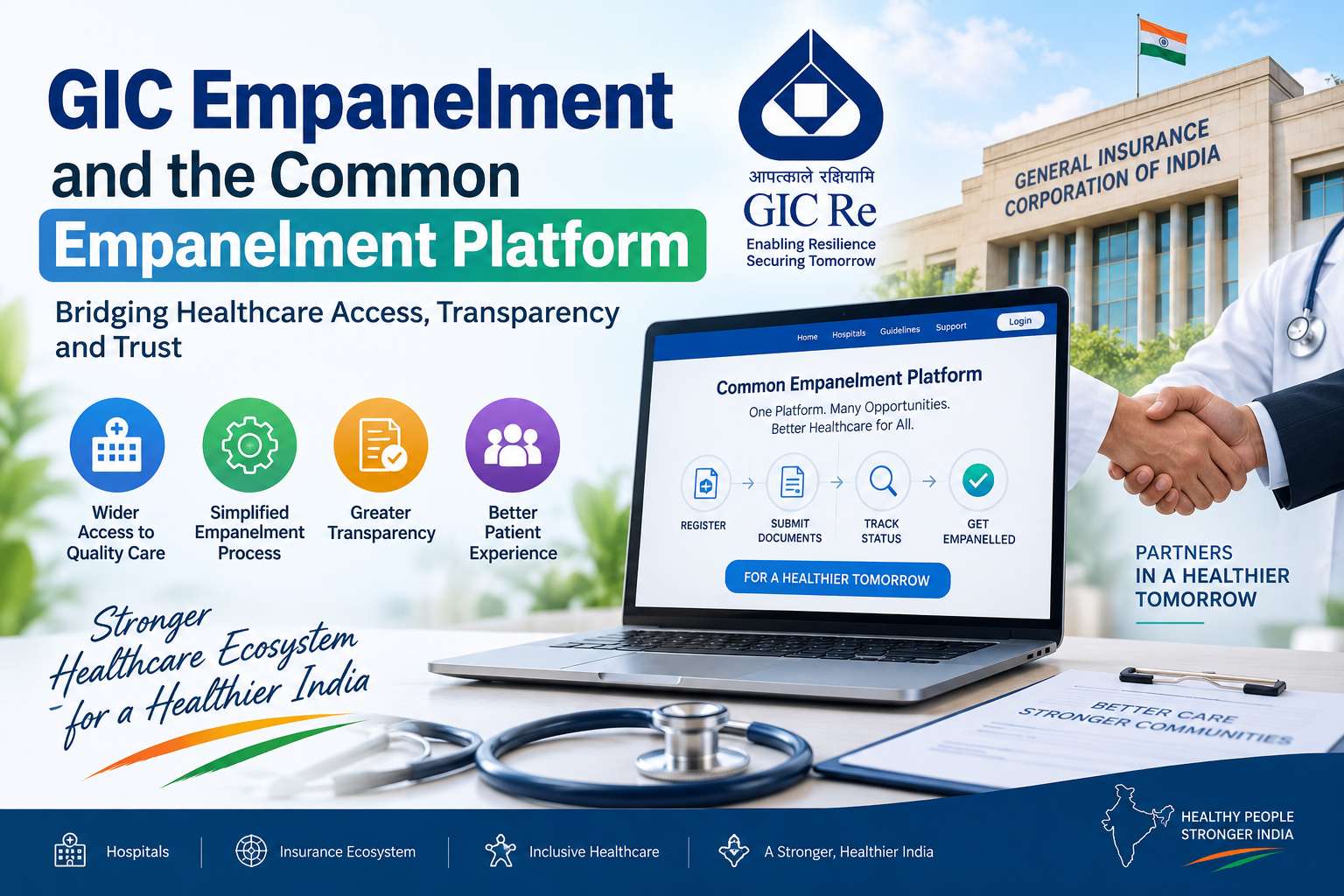
general insurers in India. It has built a Common Empanelment Platform —
a centralised digital platform managed by the Council through which a hospital
can apply for empanelment with IRDAI-registered general insurers and standalone
health insurers in a single submission, rather than approaching each company
separately.
The structure underneath it is a tripartite agreement:
the hospital signs once, with the Council and the insurers collectively,
instead of executing separate contracts with each insurer. Package rates,
payment terms and operational procedures are standardised across the network.
This came about after sustained tariff disputes between
large private hospitals and insurers. IRDAI advised insurers to move toward
common empanelment on lines similar to Ayushman Bharat, and the Council built
the platform to deliver it.
A note on terminology. Hospitals frequently use
"GIC empanelment" loosely to mean any insurance-company panel.
Strictly, GIC here is the General Insurance Council and its Common Empanelment
Platform. That is different from GIPSA — the General Insurers' Public
Sector Association, whose four public sector members operate the Preferred
Provider Network. They are separate routes with separate applications, and a
hospital typically wants both.
Where the rollout currently stands
The platform is being implemented in phases. Reported
figures indicate roughly 2,000 hospitals enrolled in FY26 against more than
10,000 applications received, with a target of around 5,000 hospitals by the
end of FY27.
Notably, the Council has prioritised smaller and
mid-sized hospitals first — enrolling them, training them and building them
into active network partners — before extending to the larger chains. If you
run a mid-sized facility, that is a meaningful signal: this is the phase in
which your application is most likely to be welcomed and processed.
What hospitals gain
One application instead of many. A single submission
reaches insurers across the market. For a hospital that has been grinding
through empanelments one insurer at a time, this is the headline benefit.
Standardised terms. Common package rates, common
documentation requirements and common processes across insurers. Your billing
team learns one system rather than fifteen.
Defined payment terms. The framework specifies
payment to hospitals within 30 days by electronic transfer. For hospitals whose
working capital is tied up in slow settlements, an enforceable payment window
matters more than a marginal rate improvement.
Scheduled rate revisions. Rates are revised on a
defined cycle — reported at every 30 months — rather than being frozen
indefinitely because nobody reopened the file.
Reduced administration. One agreement, one renewal,
one point of contact.
The genuine counter-argument
This should be stated plainly rather than glossed over,
because it is a live industry debate and your decision should account for it.
Hospital associations, including the Association of
Healthcare Providers of India, have objected that common empanelment strips
hospitals of pricing autonomy and amounts to collective bargaining by insurers
against individual providers. The concern is that standardised rates set
through a common platform will be suppressed relative to what a hospital could
negotiate on its own, and that suppressed tariffs eventually show up as
compromised care.
Insurers and the Council take the opposite view: fragmented
bilateral negotiation produced exactly the disputes and cashless suspensions
that prompted the reform, and standardisation protects patients from being
caught in the middle.
Where your hospital sits on this depends largely on your
negotiating power. A large chain with a strong brand in a major metro has real
leverage in bilateral negotiation and may reasonably prefer it. A 40-bed
hospital in a tier-II city has essentially none, and standardised rates with a
30-day payment guarantee are likely better than what it can negotiate alone. Be
honest about which of those you are.
How to approach GIC empanelment
1. Confirm your prerequisites. The same foundations
every insurance empanelment needs: clinical establishment registration, a valid
ROHINI ID, fire NOC, pollution control consent, biomedical waste authorisation,
AERB registration where applicable, and PAN and bank details in the hospital's
name. Accreditation — Pre-NABH or full NABH — strengthens the file materially.
2. Get your facility data right. Bed count broken
into general and ICU, operation theatres, specialties, equipment, 24×7
services, consultant list with qualifications and registration numbers. These
figures must be internally consistent and must match your registration
certificate. Mismatches are the most common cause of queries.
3. Understand the rate structure before you commit.
Standardised package rates mean the negotiation is less about the headline
number and more about which packages you sign up for and what sits inside each
bundle. Cost your commonly performed procedures properly — including implants
and high-value consumables — and know which packages you can deliver profitably
before you accept them.
4. Apply through the platform. A single submission
covering participating insurers. The Council operates a Common Empanelment
helpline and email for hospital queries.
5. Do not abandon your other panels. The Common
Empanelment Platform is expanding but is not yet universal. GIPSA PPN
empanelment with the four public sector insurers, direct TPA empanelments, and
government schemes — AB-PMJAY, CGHS, ECHS, DGHS, ESIC — all remain separate and
all remain worth holding. GIC empanelment adds to your network; it does not
replace it.
Sequencing GIC alongside everything else
For a hospital building its panel from scratch, the
efficient order runs:
ROHINI registration first, because insurers and TPAs
treat the 13-digit ID as a precondition for cashless empanelment.
Statutory compliance and accreditation next — fire,
pollution, biomedical waste, then Pre-NABH or full NABH. This single body of
work raises your standing with every panel simultaneously.
Tariff costing before any application, so you are
never accepting a rate you have not modelled.
Then apply in parallel — GIC Common Empanelment
Platform, GIPSA PPN, individual TPAs, and the government schemes your location
and specialty mix justify.
Finally, strengthen billing before the volume
arrives. Pre-authorisation turnaround and claim documentation discipline
determine whether a panel is profitable or merely busy.
Done in this order, each step feeds the next and the same
document set serves all of them. Done piecemeal, most of the work gets
repeated.
What to watch
The platform is still being built out. Portal functionality,
committee structures and the practical mechanics of hospital onboarding are
evolving, and published details change. Verify current requirements and status
before you finalise an application rather than relying on guidance written six
months ago — including this article.
The direction of travel, though, is not in doubt.
Standardised, centralised empanelment with defined rates and payment terms is
where Indian health insurance is heading, with regulatory backing behind it.
Hospitals that get their compliance, accreditation and costing in order now
will be in the strongest position as it scales.
How Shield Bharat helps
Shield Bharat Consulting handles GIC and GIPSA panel
empanelment alongside TPA, insurer and government scheme work. We confirm your
prerequisites and close compliance gaps, complete your ROHINI registration if
you do not hold an ID, prepare and validate your facility and consultant data,
cost your tariff and model package profitability before you commit, file and
track your Common Empanelment Platform application, and run your GIPSA PPN, TPA
and government scheme applications in parallel from the same prepared document
set. We also advise on where standardised rates work in your favour and where a
direct negotiation still serves you better.
Talk to Shield Bharat Consulting
Shield Bharat Consulting — India's trusted partner
for hospital empanelment, TPA empanelment, PMJAY, NABH accreditation and
insurance solutions. Over 15 years of industry experience, 150+ hospitals
empanelled, 3,000+ clients served.
Phone: +91 8001094000 | +91
9315211409
Email: support@shieldbharat.com
Website: shieldbharat.com
Address: Rama Road, Moti Nagar,
New Delhi 110015
Hours: Mon–Sat, 9:00 AM – 7:00 PM
| 24/7 expert support available
Need
help with GIC or GIPSA empanelment? Call us for a free panel and tariff review.