
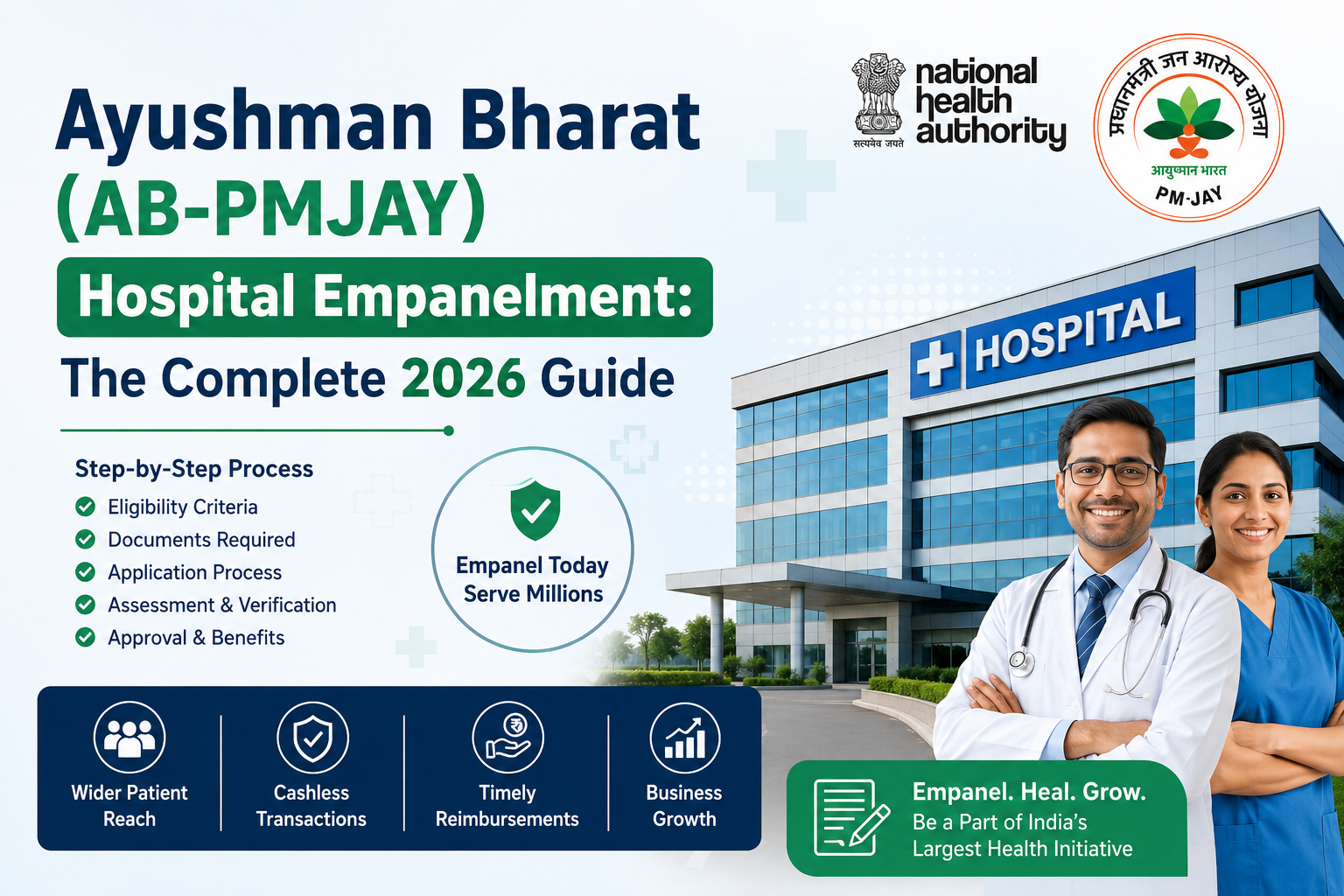
Ayushman Bharat Pradhan Mantri Jan Arogya Yojana is the
largest publicly funded health assurance scheme in the world, and for a private
hospital in India it represents something very practical: a predictable stream
of insured inpatients who would otherwise never have walked through your doors.
Yet a large number of eligible hospitals either never apply,
or apply and get stuck. The reasons are almost always the same — an incomplete
document set, an infrastructure gap that was never mapped before submission, or
a specialty scope that does not match what the hospital can actually deliver.
This guide walks through what AB-PMJAY empanelment really involves in 2026, so
you can decide whether your facility is ready and what to fix if it is not.
Why empanelment is worth the effort
Under AB-PMJAY, eligible families receive cover for
secondary and tertiary hospitalisation, delivered cashless at any empanelled
public or private hospital anywhere in the country. For the hospital, three
things follow.
First, volume. Portability means a beneficiary from
another state can be treated at your facility, which materially widens your
catchment. Second, assured payment. Claims are settled against
pre-defined Health Benefit Packages, so the revenue per case is known before
admission — a very different risk profile from self-pay patients. Third, credibility.
Empanelment signals to patients, TPAs and other government schemes that your
facility has cleared a government verification process, which makes subsequent
CGHS, ECHS and insurance empanelments noticeably easier.
The trade-off is real and should be stated plainly: package
rates are fixed and often lower than your commercial tariff, documentation
discipline is non-negotiable, and de-empanelment for fraud or non-compliance is
enforced. Empanelment is a volume play, not a margin play.
Who is eligible
The National Health Authority sets minimum criteria, but
each State Health Agency (SHA) administers empanelment in its own state and may
apply relaxations — particularly in aspirational districts and underserved
blocks. Always read your state's current notification alongside the national
guidelines.
The broad essentials are:
Registration and legal standing. The hospital must be
a registered clinical establishment under the applicable state law or the
Clinical Establishments Act, hold a valid PAN and income tax registration, and
have a NEFT-enabled bank account in the hospital's name.
Bed strength and wards. A minimum of 10 inpatient
beds with adequate spacing is the general benchmark, with separate male and
female wards. Specialty empanelment — cardiology, oncology, neurosurgery,
neonatal care — carries additional criteria on beds, equipment and qualified specialists.
Clinical manpower. Round-the-clock qualified doctors
and nursing staff. Where you seek surgical packages, qualified surgeons and
anaesthetists must be available, whether on payroll or on a documented on-call
arrangement.
Support services. A functioning pharmacy, laboratory
and access to a blood bank or storage unit, plus a casualty or emergency area
equipped with life-saving drugs and equipment appropriate to the scope applied
for.
Statutory compliances. Fire safety clearance,
biomedical waste management authorisation from the state pollution control
board, and, where applicable, AERB registration for radiology equipment.
Utilities and IT. Uninterrupted power with backup,
and the IT hardware and connectivity to run the transaction management system —
computers, internet, scanner, printer — along with the ability to maintain
electronic records as per NHA guidelines. A dedicated Pradhan Mantri Arogya
Mitra is expected at the hospital's Ayushman help desk.
The application process, stage by stage
Stage 1 — Prepare before you touch the portal. The
single biggest cause of delay is applying with a half-ready document set.
Assemble the registration certificate, PAN, cancelled cheque, fire NOC,
pollution control consent, biomedical waste authorisation, staff list with
qualifications and registration numbers, equipment inventory, bed layout, and
photographs of wards, OT, ICU, laboratory and emergency area. Decide your
specialty scope honestly at this point — claiming packages you cannot staff is
the fastest route to rejection at physical verification.
Stage 2 — Online application. Applications are filed
through the Hospital Empanelment Module on the NHA's hospital portal. You
register the facility, complete the profile, select the specialties and
packages sought, and upload supporting documents. Save the application ID;
every subsequent query is tracked against it.
Stage 3 — Scrutiny and physical verification. The
District Empanelment Committee reviews the application for completeness and
then conducts a physical inspection. The inspection verifies that the beds,
equipment, manpower and support services claimed on paper actually exist and
function. Expect questions about your OT, ICU ventilators, oxygen supply,
biomedical waste segregation and fire equipment. The NHA guidelines contemplate
this scrutiny and verification stage running to about 15 working days, though
real timelines vary by district.
Stage 4 — Recommendation and approval. The DEC
recommends approval, approval with relaxation of specified criteria, or
rejection with reasons. The State Health Agency takes the final decision, with
the overall process framed at around 30 working days and notification of the
outcome within a few working days of the decision.
Stage 5 — Agreement and go-live. On approval the
hospital executes the empanelment agreement, typically within a week, and then
receives system credentials and training on the transaction management system —
pre-authorisation, claim submission and beneficiary verification — usually within
about 15 days.
Quality certification: the incentive most hospitals overlook
The NHA, with NABH and QCI, runs a tiered quality
certification linked directly to what you are paid. Bronze certification is
aimed at hospitals with at least 10 operational beds and involves a desktop
review followed by an on-site assessment. Silver is for empanelled hospitals
holding NABH Entry-Level Certification, and Gold for those with full NABH
accreditation or NQAS. Silver and Gold are assessed by desktop review.
The incentive is a supplementary payment on health benefit
package rates — reported at 5% for Bronze, 10% for Silver and 15% for Gold. For
a hospital doing meaningful PMJAY volume, moving from uncertified to Silver is
a direct and permanent uplift on every claim. If you are planning empanelment,
plan the NABH entry-level pathway alongside it rather than years later.
Why applications get rejected
In practice, rejections cluster around a short list: missing
or expired fire safety and pollution control clearances; manpower on paper that
cannot be produced during inspection; specialty packages claimed without the
corresponding equipment or specialist; bed count that does not match the
physical layout; and incomplete or illegible document uploads. Each of these is
fixable before submission — which is exactly why pre-application readiness
assessment pays for itself.
After empanelment, the compliance obligations continue.
Fraudulent or inflated billing, upcoding of packages, wrongful beneficiary
identification and failure to maintain quality standards are grounds for
suspension or de-empanelment. Build your claims process around documentation
discipline from day one.
A practical readiness checklist
Before you apply, confirm you can answer yes to all of the
following: the clinical establishment registration is current; fire NOC and
pollution control consent are valid and not expiring within six months;
biomedical waste authorisation is in place; you have at least 10 functional
inpatient beds with separate male and female wards; you have 24×7 doctor and
nursing cover documented on a duty roster; your laboratory and pharmacy are
functional; your emergency area has life-saving equipment; you have a computer,
scanner and stable internet at the help desk; and every specialty you intend to
claim has a named, qualified specialist attached to it.
If any answer is no, close that gap first. An application
withdrawn and refiled costs weeks; an application rejected at DEC stage costs
credibility with the district committee you will face again.
How Shield Bharat helps
Shield Bharat Consulting has handled empanelment for more
than 150 hospitals across India. For AB-PMJAY we conduct a pre-application gap
assessment against the current national and state criteria, assemble and
validate the complete document set, file and track the application on the
hospital empanelment portal, prepare your team and your premises for the
District Empanelment Committee inspection, respond to queries raised during
scrutiny, and support agreement execution and TMS onboarding. We also map the NABH
entry-level pathway so you can move up the quality-certification incentive
tiers rather than leaving that revenue on the table.
Talk to Shield Bharat Consulting
Shield Bharat Consulting — India's trusted partner
for hospital empanelment, TPA empanelment, PMJAY, NABH accreditation and
insurance solutions. Over 15 years of industry experience, 150+ hospitals
empanelled, 3,000+ clients served.
Phone: +91 8001094000
Email: support@shieldbharat.com
Website: shieldbharat.com
Address: Rama Road, Moti Nagar,
New Delhi 110015
Hours: Mon–Sat, 9:00 AM – 7:00 PM
| 24/7 expert support available
Ready
to get your hospital empanelled under Ayushman Bharat (AB-PMJAY)? Call us for a
free eligibility assessment.